Like other capital-intensive industries with long asset cycles and high uncertainty, oil and gas (O&G) goes through periods where companies use M&A more intensively to create value. But today, many O&G companies are pursuing a more complex subset of M&A: mergers of equals or business combinations that create new companies, satellite companies, or larger companies that operate like new entities. Recent transactions demonstrate that the industry is using these deals not only to create new operating architectures but also to consolidate positions in advantaged basins, secure infrastructure, and access capital.
This context makes our “transact to transform” approach particularly relevant. This approach treats deals as unique change windows. It encourages leaders to execute full-potential integrations, where they strive to achieve top-quartile performance for the combined enterprises. In O&G combinations specifically, this requires improvements in the performance of wells, facilities, people, processes, technology, contracts, and capital. Our approach also challenges companies to rigorously sequence integration initiatives so that scarce resources are available at the right moment. Although sequencing integration initiatives is important in any industry, it’s particularly crucial in the highly physical O&G industry. A strong sequencing plan captures quick wins early, uses them to fund and derisk deeper structural changes, and avoids overloading teams. Without disciplined sequencing, even a strong deal thesis can lose momentum because the highest-value initiatives may arrive before the organization is ready to execute them.
The article begins by exploring recent O&G combinations that illustrate how companies are using deals to transform. It then briefly describes the five pillars of the transact-to-transform approach before examining two of them—the foundational concepts of setting higher ambitions for the deal and using sequencing to execute the vision—in depth. Finally, we conclude with action steps for those leading transformational transactions.
Recent combinations illustrate the system redesign opportunity
In O&G, a large transaction can change a company’s trajectory because the value of an asset often increases when combined with assets around it. Contiguous acreage can enable longer laterals, fewer facilities, better pad design, higher working interest, and more efficient development sequencing. Owned infrastructure can reduce gathering constraints, improve uptime, and lower cash costs. Downstream, liquefied natural gas (LNG) or export-market access can reduce exposure to local differentials. A stronger balance sheet can shift capital toward the lowest-cost barrels. Some transactions create several of these advantages at once.
ExxonMobil’s acquisition of Pioneer Natural Resources is an interesting example of how M&A is targeting value in the Permian Basin. At announcement, the deal combined ExxonMobil’s roughly 570,000 net acres with Pioneer’s roughly 850,000 net acres, creating a combined 16 billion barrels of oil equivalent. ExxonMobil said the deal combined Pioneer’s basin knowledge, entrepreneurial culture, and differentiated Permian inventory with ExxonMobil’s proprietary technologies, financial resources, and project development capabilities. In operational terms, the adjacency allowed ExxonMobil to drill laterals up to four miles, reducing the number of wells and surface facilities required; to apply cube development techniques to stacked resources more efficiently; and to expand field digitalization and automation to optimize production throughput and cost.
As the integration proceeded, ExxonMobil raised its expectation for Pioneer-related synergies to $4 billion annually by 2030 and targeted roughly 2.5 million barrels of oil equivalent per day of Permian production by 2030. The company attributed these improvements in part to proprietary technologies and scale efficiencies; it also cited early results showing about 20 percent recovery improvement from lightweight proppant technology alone.
Devon-Coterra was an all-stock transaction. Management expected to generate $1 billion worth of synergy benefits and value through more disciplined capital allocation, operating-margin improvements, lower corporate costs, integrated technology platforms, and the use of AI across subsurface, operations, and enterprise functions. Margin improvements included streamlined operations, enhanced infrastructure in the Delaware Basin, and integrated technical expertise to optimize production.
Additional recent transactions illustrate how companies can use M&A to create businesses designed around a particular geography. Eni and PETRONAS created Searah; Shell and Equinor created Adura; Eni UK combined with Ithaca; BP and Eni created Azule Energy; and Eni and HitecVision combined assets to form Vår Energi. In each case, the companies created a business focused on a specific basin or region, with its own management team and operating priorities. Searah was created to pursue growth in Malaysia and Indonesia, with an initial production base above 300,000 barrels of oil equivalent per day and a medium-term target above 500,000 barrels of oil equivalent per day. Adura was created to operate in the mature UK North Sea, where cost control, asset life extension, and operational execution are particularly important. Azule was created as Angola’s largest independent equity producer, and management expected its integrated operating model to reduce costs, particularly in logistics and technology.
Eni-Ithaca is a good example of how the order of transactions can influence value creation. In January 2024, Eni acquired Neptune Energy, strengthening its UK and Northern European portfolio. In October 2024, it combined its UK upstream business with Ithaca, creating an enlarged UK Continental Shelf platform in which Eni retained about 38.5 percent ownership. The goal was to create a company built around UK Continental Shelf assets with opportunities for growth and operational improvements. By first expanding its portfolio and then combining assets into a new platform, Eni used a sequence of transactions to build a business around a specific geography and asset base.
Applying the transact-to-transform approach to O&G
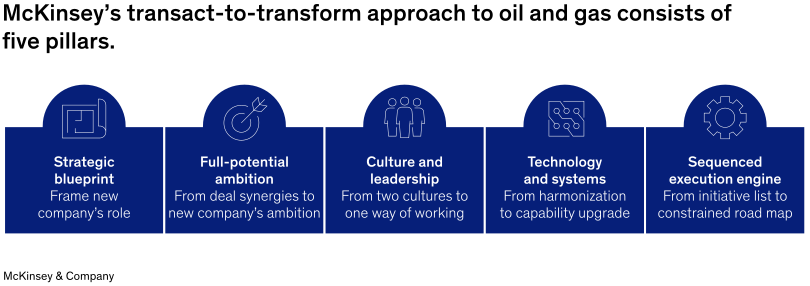
Our transact-to-transform framework consists of five mutually reinforcing elements (Exhibit 1), which have specific definitions in an O&G context:
- Strategic blueprint for the newly created entity. Define the role of the combined company, basin or regional strategy, governance model, and principles that will guide investment decisions.
- Full-potential ambition. Quantify value beyond tactical synergies, including revenue/production, cost, capital productivity, infrastructure, and commercial levers, bringing the merged companies to top-quartile performance in the market.
- Culture, leadership, and talent integration. Choose which leadership and cultural attributes, decision rights, safety culture, and operating cadence from each company to implement in the new entity.
- Technology, data, and systems harmonization. Decide where to harmonize and where to adopt the better platform. Use the transaction as an opportunity to adopt more advanced technologies (including AI, digital field tools, production analytics, enterprise resource planning/land systems, and data architecture) than either company was using before.
- Sequenced-execution engine. Translate ambitions into initiatives, assigning to each the right owners, milestones, and capital requirements. Sequence steps against constrained resources to make sure each initiative can be pursued when its time comes.
Discovering the full potential of an O&G transaction
A full-potential assessment starts with traditional synergy analysis but expands the search for value into areas such as drilling and completions, capital allocation, and commercial optimization. Traditional integration efforts often focus on reducing overhead costs, consolidating procurement, and eliminating duplicate systems. A full-potential approach goes further by asking what top-quartile performance would look like for the combined company and what would need to change to achieve it. Leaders examine wells, facilities, people, processes, technology, contracts, and capital to identify required changes.
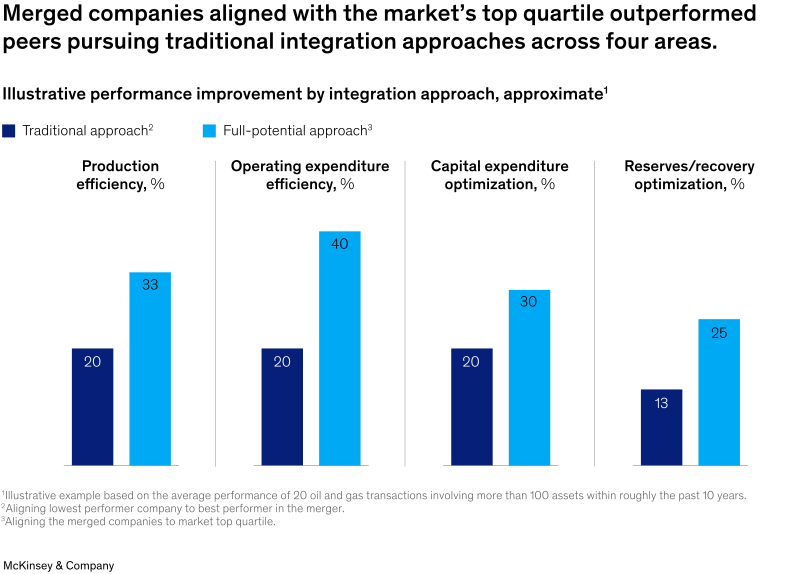
What’s surprising about this approach is how it optimizes traditional synergies. According to McKinsey’s analysis of 20 O&G deals over roughly the last decade involving more than 100 assets, applying the full-potential approach enabled more synergies than the traditional approach (Exhibit 2). Raising new entities to top-quartile performance allowed on average roughly 33 percent greater production efficiency (versus 20 percent for companies pursuing traditional synergies); 40 percent greater operating-expenditure efficiency (versus 20 percent); 30 percent more capital expenditure optimization (versus 20 percent); and 25 percent more recovery/reserves optimization (versus 13 percent). In sum, the full-potential approach enabled roughly 55 percent higher synergy achievements across levers compared with the traditional synergy approach.
Leaders taking a full-potential approach then look beyond synergies, earnings growth, or cash flow to identify value-creating operational improvements. For a shale deal, these might include optimizing drilling days per well, lateral length, completed-well cost per lateral foot, recovery factor, base decline, lease operating expense per barrels of equivalent, water cost per barrel, gathering uptime, emissions intensity, and capital efficiency. For a company created to operate in a specific region or asset base, improvements might include better portfolio renewal, project cycle time, field uptime, capital self-sufficiency, and decision cycle speed.
Diamondback’s acquisition of Endeavor Energy illustrates the value of looking beyond traditional cost synergies. The company targeted approximately $550 million in incremental value, including about $325 million from capital and operating-cost savings, about $150 million from capital allocation and land savings, and about $75 million from financial and corporate savings. Most of the value was expected to come from improving how the combined company developed assets, managed land, allocated capital, and operated in the field rather than from corporate cost reductions alone. Diamondback’s Midland Basin well costs ranged from $555 to $605 per foot, approximately $45 per foot lower than the prior year. Faster drilling helped: Improvements in drilling fluids and downhole equipment helped reduce the time required to drill a 13,000-foot lateral to roughly seven days. The company also expanded the use of SimulFrac and electric completion fleets, allowing multiple wells to be completed more efficiently while reducing fuel costs. Beyond drilling and completions, standardized facility designs were expected to reduce infrastructure costs by about 10 percent per foot drilled, while procurement scale and operational practices inherited from Endeavor were expected to generate additional savings across the asset base.
The importance of sequencing integration steps
More than in most industries, the success of an O&G integration depends on how effectively the combined company coordinates its physical assets. Wells, infrastructure, equipment, and technical resources are often shared across multiple value creation initiatives, making it impossible to pursue every opportunity at once. Successful sequencing requires planning integration activities so that the resources and talent required for each initiative are available when they are needed, rather than tying them up in competing priorities. Many O&G integrations fall short because they assume more capacity, time, or organizational bandwidth than is actually available.
The first sequencing task is to identify the resources that can bottleneck value capture. In operations, those resources may be rigs, frac spreads, water disposal capacity, land systems, engineering talent, and vendor transition bandwidth. In gas–midstream combinations, the bottlenecks often include governance decisions, leadership selection, cultural integration, data migration, and harmonization of enterprise resource planning and production systems. Leaders must also maintain health, safety, and environmental performance and operational stability while running the new company.
The second task is to prioritize value creation opportunities based on how quickly they can realistically be implemented. Corporate overhead, public-company costs, insurance, procurement, and capital governance changes can often be addressed in the first six to 12 months. Operations (including drilling redesign, production optimization, field automation, and water network integration), data harmonization, and supply/logistic topics (such as facility rationalization) usually take longer due to complexity. The transformation of a new company’s culture and systems also needs to be sequenced. Leaders may choose to establish the company’s operating model first but delay IT migrations and data model changes until the new organization is operating effectively and day-to-day activities are stable.
Chesapeake-Southwestern, now Expand Energy, illustrates how sequencing can help a company capture more value than the initial synergy case suggests. The initial synergy case targeted approximately $400 million worth of annual operational and overhead savings and full value capture by the end of 2027. In 2025, the company focused on capturing value from general and administrative reductions, longer laterals, lower drilling and completion costs, and shared field infrastructure. Throughout 2026, it plans to focus on initiatives including drilling more efficiently and optimization of completion designs. The company revised its value capture target to $600 million in annual synergies and accelerated the timeline to the end of 2026, demonstrating how sequencing more complex operational levers after the operating system stabilizes can enable higher aspirations.
Putting it all together: How O&G leaders can transact to transform
As discussed above, before committing to a transaction, leaders can develop a clear view of how the combined company will create value. The analysis should go beyond traditional cost synergies and reductions in general and administrative expenses and identify the specific operational, commercial, and capital allocation improvements that could make the combined business more valuable than either company on its own. Developing the plan before close can help leaders prioritize the initiatives that matter most and begin preparing to capture value from day one.
Leaders can also design their approach to culture, governance, and talent in ways that support value creation. This is particularly important in mergers of equals and business combinations, where neither company has an obvious mandate to impose its culture and systems on the combined organization. The leaders of the new entity will need to choose which elements of each company’s culture, leadership approach, and ways of working should be implemented.
Finally, leaders can be explicit about both the value they expect to create and the timeline for capturing it. A credible value creation plan reflects the reality that some improvements can be implemented quickly, while others require years of operational, organizational, or technical change. Meticulous sequencing enables companies to position themselves for success at each step of their value capture plan. Company examples illustrate how much the pacing can vary by deal: ConocoPhillips targeted $500 million of savings within the first full year after the Marathon acquisition closed and later raised that ambition; Devon-Coterra is targeting $1 billion by year-end 2027; and ExxonMobil expects Pioneer-related synergies to reach $4 billion annually by 2030.
O&G is entering a period of elevated M&A activity—and particularly of mergers and combinations—as companies respond to price volatility, seek greater scale, and look for new ways to create value. The companies that can benefit most from this wave of dealmaking treat it as more than a chance to capture synergies. The real opportunity is to envision how a combined company can operate more effectively than either company could on its own. As noted above, by meticulously sequencing the integration, leaders can keep integrations on track and position new entities to successfully capture value at each stage. When done well, this approach can turn a transaction from a simple combination of assets into a transformation that leads to lasting value creation.