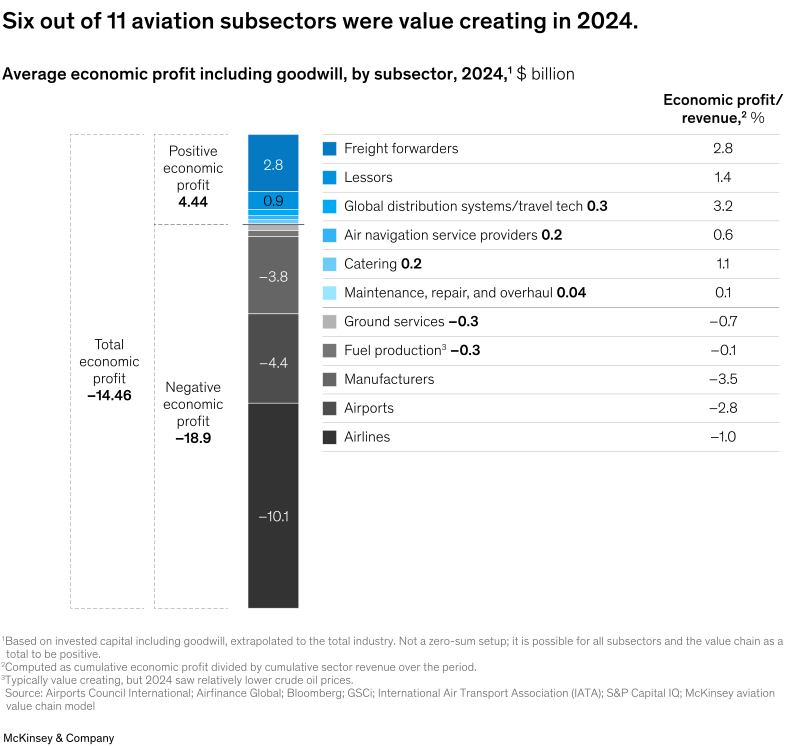
Since 2005, our annual analysis of the aviation value chain’s financial performance has helped highlight trends and developments in the sector. Our newest review, based on 2024 data, indicates a mixed year. Six of the 11 subsectors we track achieved positive economic profit, but the overall result was a clear downtick: The aviation value chain recorded a 2024 economic loss of roughly $14 billion—significantly larger than 2023’s $6 billion loss and worse than the industry’s average loss of $10 billion per year during the 2012 to 2019 prepandemic period.
Unpacking these outcomes reveals broader themes and diverging performance levels:
- In every subsector, we see value-creating parties, yet subsector-level results are dragged down by the magnitude of the worst performers’ losses.
- The airline sector’s loss was larger than in 2023 but remains smaller than during the 2012 to 2019 period—with a relatively high share of airlines again creating value.
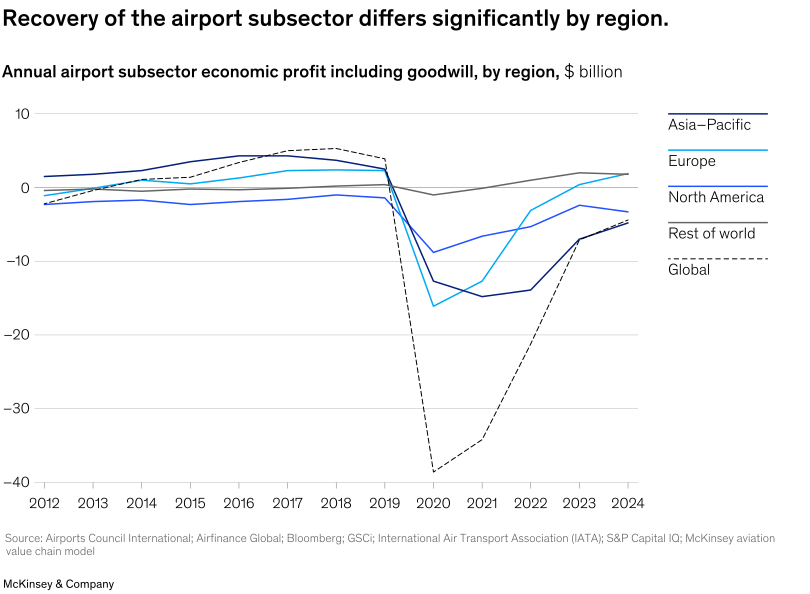
- Airports’ overall performance was negative—despite airport traffic having now fully recovered to prepandemic levels—though performance differs significantly by region.
- Aircraft and engine manufacturers continue to face considerable challenges.
- Several segments that have historically been value creators once again achieved positive results after overcoming recent downturns.
Our measure of value creation is economic profit, defined as the difference between ROIC and the alternative return from equal-risk opportunities that investors can access.1 We analyze participants from across the value chain, including airlines; OEMs that produce aircraft and engines; aircraft lessors; air navigation service providers; jet fuel producers; airports; catering suppliers; ground services companies; maintenance, repair, and overhaul organizations; freight forwarders; and providers of global distribution systems and other travel technologies.
Below, we take a detailed look at the numbers.
Value creation varied by subsector
As a whole, the aviation value chain recorded an economic loss of roughly $14 billion in 2024. By comparison, the average annual loss in the prepandemic period from 2012 to 2019 was approximately $10 billion and 2023’s loss was only $6 billion.
The sectors with the largest profits in 2024 were freight forwarders, aircraft lessors, and global distribution systems (which are centralized reservation systems that connect airlines with travel agents and other ticket distributors around the world). Airports, airlines, and OEMs suffered the largest losses in absolute terms, just as they did in 2023. Six of the 11 subsectors we track showed positive economic profit.
Results shifted for many aviation segments
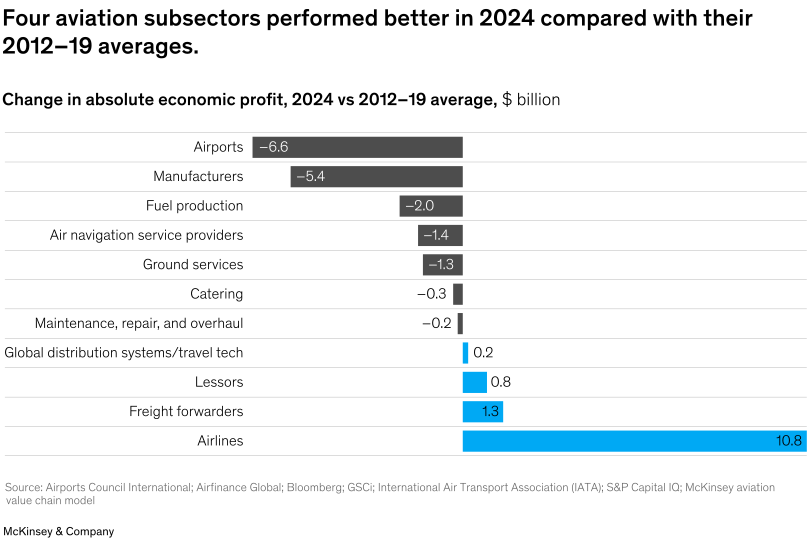
Seven aviation subsectors performed worse in 2024 compared with their 2012 to 2019 averages. Airports recorded the largest downtick, with the declining performance of Asia–Pacific airports weighing heavily on global results.
Four sectors improved performance relative to the 2012 to 2019 period: global distribution systems, aircraft lessors, freight forwarders, and airlines. Airlines achieved the largest profit increase of any subsector when compared with the 2012 to 2019 period.
Airlines presented a mixed picture
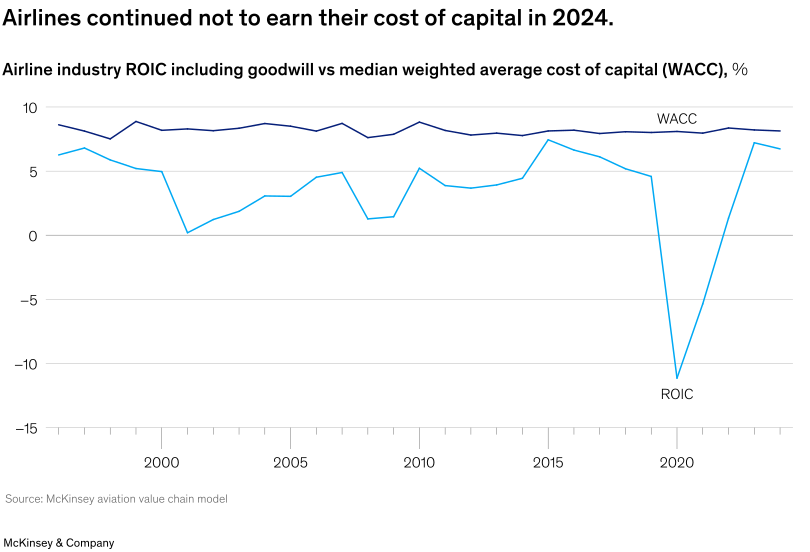
Although airlines’ collective economic performance continued to be better than the 2012 to 2019 average, our analysis shows that the airline sector’s ROIC remained below the weighted average cost of capital (WACC) in 2024—as has been the case dating back to at least 1996. The share of value-creating airlines in our sample (meaning airlines that achieved ROIC higher than WACC) was 36 percent—above the longer-term trend but lower than in 2023, when 46 percent of our airline sample was value creating.
Year-over-year demand growth (measured through revenue passenger kilometers flown) was a robust 10.6 percent in 2024. Demand outgrew supply, with year-over-year growth in available-seat kilometers flown at 8.8 percent. Cargo yields dropped, but cargo revenue remained at roughly 150 percent of what it was in 2019.
Thus far, 2025 appears to be a mixed picture for airlines. Geopolitical tensions have led to uncertainty. Changes in tariffs have affected cargo flows. On the positive side, demand—especially premium demand—remains strong. Passengers appear willing to pay for better experiences. The composition of premium cabins has also changed over time, with an increased share of leisure travelers sitting at the front of the plane. Business class and first class passenger revenues from January through September of 2025 were up about 3.5 percent compared with the same period in 2024, and revenue increased 3.3 percent for all classes combined. Meanwhile, the price of jet fuel, which represents the largest single cost item for airlines, is (as of early November 2025) down about 9 percent from 2024 levels and down about 22 percent from 2023 levels.
North American low-cost airlines continue to navigate headwinds
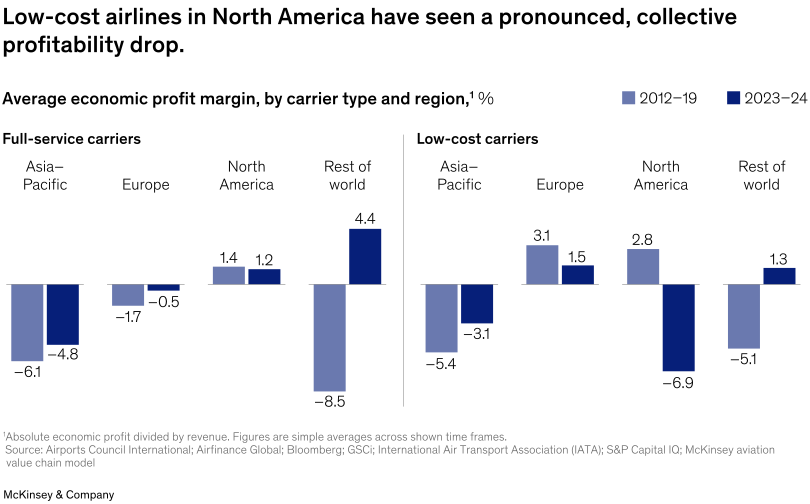
In 2023 and again in 2024, the low-cost airline model was significantly less successful in North America than it had been during the prepandemic period from 2012 to 2019. McKinsey research suggests several potential causes:
- Network carriers have been effective in offering fully unbundled “basic economy” products.
- Network carriers are better positioned to tap into robust premium demand.
- The unit cost gap between network carriers and low-cost carriers has narrowed, in part because of rises in labor costs (which weigh more heavily on the cost bases of low-cost carriers).
- Network carriers are better able to generate revenue linked to loyalty programs.
This dynamic is less pronounced in other parts of the world. Meanwhile, better overall airline performance in the Middle East and South America has boosted collective results for regions outside of Asia–Pacific, Europe, and North America.
Airports are still recovering, though results differ by region
Airports collectively lost roughly $4 billion in 2024. This is significantly better than the $7 billion loss global airports recorded in 2023 but still far short of the average annual result in the prepandemic period of 2012 to 2019.
Results varied by region. For the second year in a row, airports in Asia–Pacific and North America operated at a loss, while airports in Europe and the rest of the world produced positive economic profit. Performance in the Asia–Pacific region—facing challenges such as slower passenger traffic recovery, rising labor costs, and additional costs stemming from capital expenditures and debt service—continues to be the largest driver of loss for the airport sector.
Some volume-dependent subsectors saw improved performance
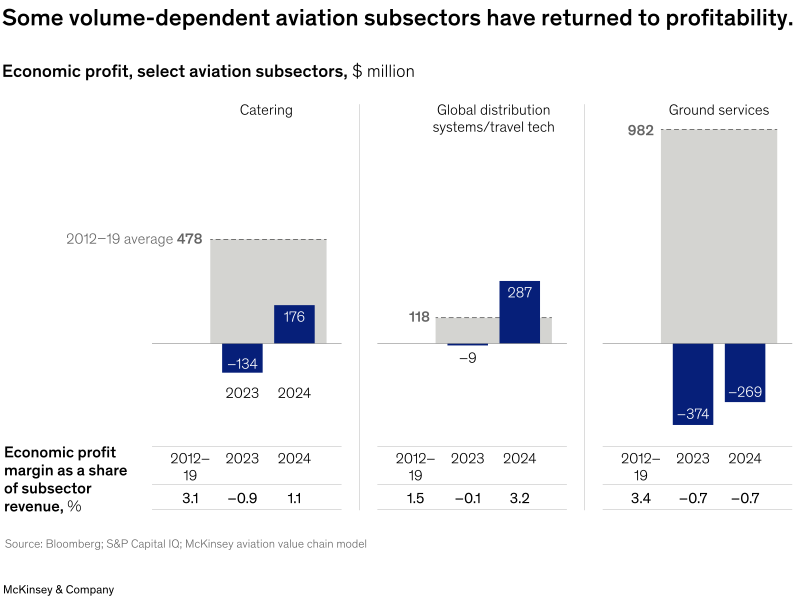
When measured by passengers handled, global air traffic in 2024 was approximately 5 percent higher than in 2019. But when measured by the number of flights performed, 2024 traffic was essentially flat compared with 2019. Perhaps relatedly, some value chain sectors that are volume dependent on passenger flows—such as catering and global distribution system companies (which can also provide travel tech, including specialized software for airlines)—swung back to positive economic profit in 2023 after down years.
Ground handlers—a category that can include above-the-wing services such as passenger and baggage check-in and below-the-wing services such as aircraft pushback—are also a volume-dependent segment. But ground handlers did not recover to the same degree in 2024, notching an economic loss of approximately $270 million (or –0.7 percent when expressed as a ratio to revenue). This was slightly better than the loss ground handlers posted in 2023 but far below results from the 2012 to 2019 period, when this segment showed positive economic profit. Rising labor rates could be one factor, as labor is the ground handlers’ single largest cost component.
Although air passenger traffic has fully recovered from the depths of the pandemic, the aviation value chain is facing some new headwinds—including geopolitical tensions. Economic profit performance varies significantly by sector, region, and business model type, but the value chain as a whole continues not to earn its cost of capital. Improved resilience and innovative ideas could help the industry navigate through a turbulent moment.