Education is one of the most powerful long-term investments available to societies.1 Strong education systems drive productivity, earnings growth, and social mobility—and education investments can often generate sustainable market rate financial returns.2
Despite this, education remains structurally underfinanced by public and private sectors, especially in low-and-middle-income countries (LMICs). UNESCO estimates there is a $97 billion annual funding gap to meet even the basics of the United Nations Sustainable Development Goal (SDG) 4: ensuring inclusive and equitable quality education and promoting lifelong learning opportunities for all.3 Historically, official development assistance (ODA) played an important role in improving educational access, quality, and equity. But recent cuts threaten to decrease this critical source of funding by nearly a quarter, widening the funding gap by an additional $3.2 billion, as projected by UNICEF.4 If SDG 4 is to be met, the education funding community will need to increase access to education funding and improve the effectiveness of existing capital across education levels.
Private capital, which currently accounts for about 15 to 40 percent of global spending on education,5 can provide a vital thread of funding in countries with strapped government budgets. However, in many LMIC markets, a set of market failures, including inaccurate perceptions of risk, results in underinvestment in education by private actors. Private philanthropy can act as a catalyst to derisk private capital and bring in more of this powerful resource. Beyond traditional grant-making, a host of innovative financing mechanisms can address the twin goals of increasing access to capital and effectiveness of existing capital in the education financing system. But the complexity and wide variety of mechanisms often deter philanthropic actors from these types of investments.
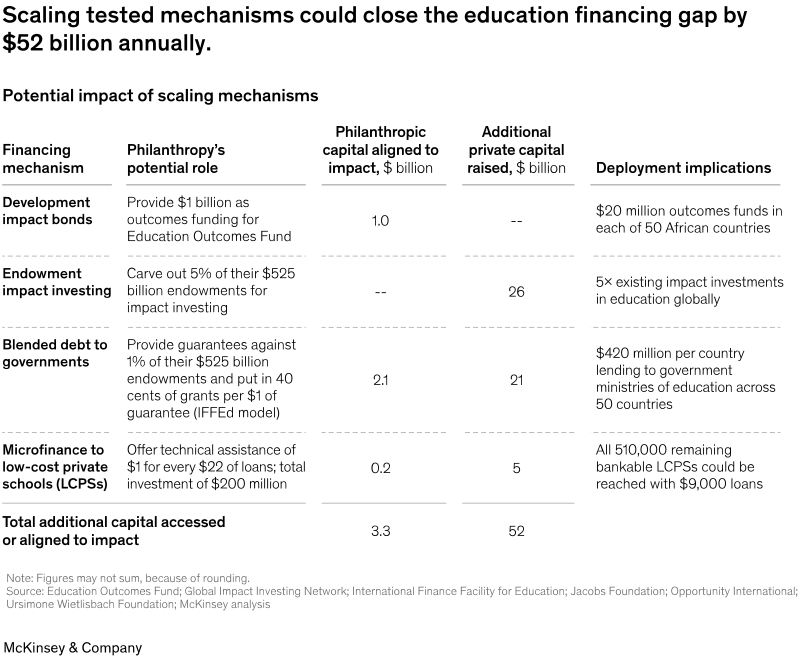
This report aims to demystify innovative financing mechanisms (see sidebar “About the research”). Scaling only those mechanisms that have already been proved in education could close $52 billion of the annual education financing gap as well as improve the effectiveness of existing funding. Additional emerging mechanisms also hold great promise, and with more innovation and research, they could play a part in closing the remaining gap, accelerating progress toward SDG 4 and a quality education for all students.
The challenge: Uneven outcomes and insufficient funding
Over the past two decades, global progress in education has been uneven and fragile. Enrollment rates have risen substantially, particularly at the primary level, and major efforts in foundational learning have led to the development of proven practices. In Brazil, for example, the state of Ceará improved learning outcomes by 12 percentage points on the Brazilian national education assessment by applying structured pedagogy approaches.6 In Punjab, India, leaders used Teach at the Right Level approaches to improve performance by 13 percentage points on the Indian Annual Status of Education report.7
The challenge is implementing these proven practices at scale.8 Global learning suffers from a structural financing gap (Exhibit 1). African countries represent 56 percent of low-income and lower-middle-income countries but account for 79 percent of the financing gap.9
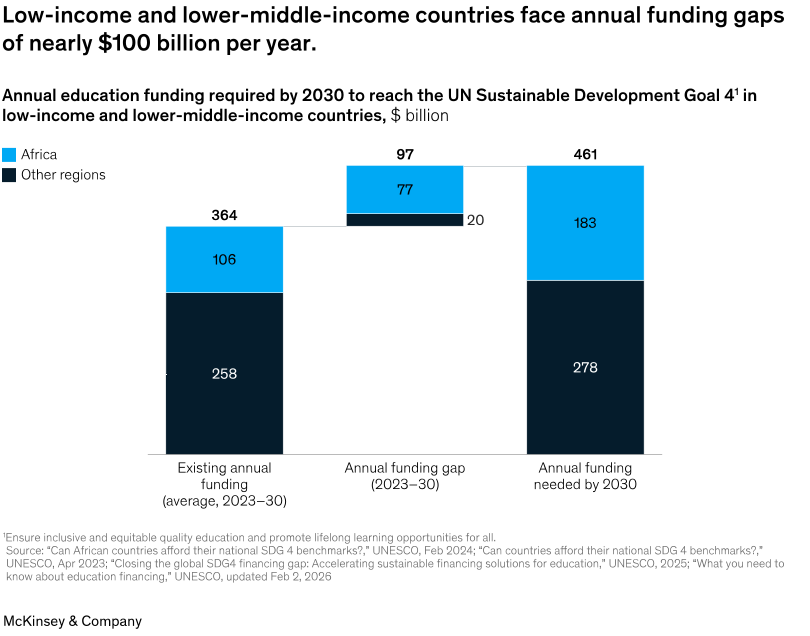
Recent trends have further widened the financing gap. Announced cuts to ODA were projected to reduce global education aid by up to a quarter between 2023 and 2026, or roughly $3.2 billion.10 These reductions come at a time when many countries are still recovering from pandemic-related learning losses and fiscal stress. The likely consequences are severe: millions of additional children at risk of dropping out, deterioration in education quality for hundreds of millions more, cuts to school food and gender-focused programs, and long-term losses in lifetime earnings.
Although ODA represents a relatively small share of total education spending, its influence is disproportionate. Aid often finances foundational learning reforms, funds pilots of innovative delivery models, supports fragile and conflict-affected settings, and provides technical assistance that shapes national policy.
At the same time, domestic public spending—the backbone of education finance—faces hard constraints. Many governments in LMICs are grappling with high debt burdens, limited formal tax bases, and competing priorities such as health, energy, and climate adaptation. Even where political commitment to education is strong, ministries often struggle to translate budgets into learning outcomes due to weak procurement and limited management capacity.
The result is a mismatch between ambition and reality: a global commitment to education as a human right and economic necessity, but a financing architecture that is fragmented, input-focused, and increasingly under strain.
The imperative: Increasing access to capital and effectiveness of existing capital
Addressing the education financing crisis requires both mobilizing more capital—from governments, households, corporations, and investors—and increasing the effectiveness of every penny spent.
Globally, governments account for most education spending, with private expenditures of employers, households, and investors ranging from roughly 15 to 40 percent.11 In OECD countries and parts of Asia, private providers and investors operate across a wide range of segments, from direct provision of education to learning and administrative software and services. By contrast, in many developing countries, private capital remains heavily concentrated in higher education and urban markets, leaving basic education and rural areas underserved. Ideally, governments could cover the foundational educational needs of all their citizens to preserve equity across income levels. But government systems are often overstretched, and private capital can help to bridge the gap.
Impact investing, defined as investments that aim to realize both financial and social returns,12 has grown rapidly over the past decade, nearing $100 billion in assets under management.13 Education accounts for only a small fraction of these allocations—about $5 billion globally, equivalent to about one-third of 2024 ODA spending.14 While nearly a third of impact investors say they plan to increase their exposure to education, they consistently cite barriers such as unclear revenue models, regulatory risk, limited deal flow, and challenges in measuring impact.15 Some of these barriers can be readily overcome; for example, low-cost approaches to measuring learning outcomes are increasingly available. Others may be tougher to tackle.
This is where innovative financing models become essential. Redesigning how capital from a wide variety of sources flows into education—and under what conditions—makes it possible to both expand the pool of available funding and align spending more closely with learning results.
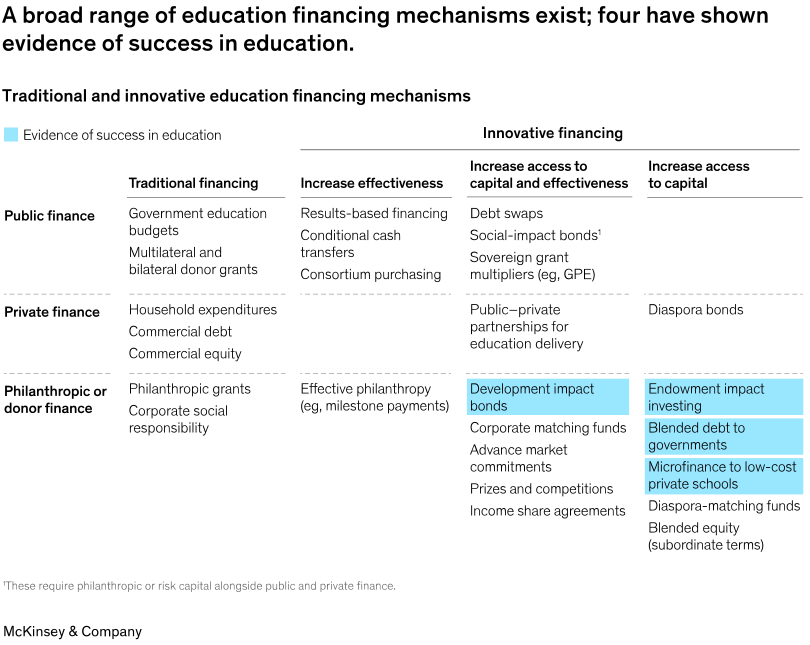
Just as traditional financing can be categorized as coming from public, private, or philanthropic sources, innovative financing mechanisms can be similarly categorized as relating primarily to public expenditures, coming from private finance, or including philanthropic or donor finance as a catalyst. Some innovative financing mechanisms only focus on increasing the effectiveness of funds; others focus primarily on increasing access to new capital. A subset do both. Four of these mechanisms have shown evidence of success in education at some scale, with promising examples from several countries. Others are emerging but hold great promise (Exhibit 2).
The role of private philanthropy: Catalyzing new funding through innovative financing mechanisms
Private philanthropy occupies a distinct position in the education financing ecosystem. Unlike governments, it is not bound by electoral cycles or rigid procurement rules. Unlike commercial investors, it can accept below-market returns or take first losses. And unlike multilateral lenders, it can move relatively quickly and experiment with new approaches. These characteristics make private philanthropy uniquely suited to act as a catalyst.
Currently, much philanthropic capital in education goes to traditional program grants—funding that helps nonprofits achieve specific educational goals during a specific period for a specific geographic population. Such grants can have great impact, but a host of additional mechanisms are available to help philanthropies multiply their impact by catalyzing and influencing much larger sources of funding.
Four of these mechanisms have been tested and have proved effective in education. One, development impact bonds (DIBs), focuses primarily on improving the effectiveness of existing funds. The remaining three—endowment impact investing, blended debt to governments, and microfinance to low-cost private schools (LCPSs)—are more focused on bringing net new capital into the system. McKinsey estimates that if private philanthropists diverted approximately $3.3 billion of grant funding and aligned a portion of their endowments to impact, they could catalyze an additional $52 billion into education in LMICs annually (Exhibit 3).
Other emerging mechanisms, such as income share agreements, diaspora-matching funds, social-impact incentives, advance market commitments, prizes, and blended equity, hold great promise but need innovation and research to scale in education (see sidebar “Emerging mechanisms hold great promise”).
Below, we explore the proven mechanisms in detail.
Development impact bonds: Enforcing outcomes and showing what works
DIBs are the mechanism most closely associated with innovative financing. They fundamentally align donor and government funding to outcomes achieved rather than inputs.
DIBs typically involve four sets of partners:
- An outcomes funder (such as a philanthropy) funds projects designed to deliver specific outcomes, such as student attendance or reading outcomes. The funder pays only if outcomes are achieved.
- Risk capital (for example, an impact investor) pays for initial delivery costs. If the outcomes are achieved, the outcomes funder repays the investor, who can recycle capital into new projects.
- A delivery partner, such as a nonprofit organization, delivers the project. Scaling is dependent on achieving outcomes.
- A third-party evaluator manages performance and verifies outcomes.
DIBs don’t fundamentally add new money to the system, because the risk capital is eventually repaid if outcomes are achieved. But by aligning incentives toward desired educational outcomes, they improve the effectiveness of existing funding. And though they are often criticized for their complexity, the work done up-front to define outcomes and measurements can uncover potential issues earlier in the process than in more traditional grants.
Notable success stories
Most DIBs to date have been of small to moderate scale, but several have seen notable success.
Quality Education India (QEI): Between 2018 and 2022, this DIB invested $11 million to improve foundational literacy and numeracy outcomes for about 200,000 primary school children in multiple states across India.16 Outcomes funders included the Michael & Susan Dell Foundation and a consortium of donors convened by the British Asian Trust, while risk capital was provided by the UBS Optimus Foundation. Work was carried out in close partnership with state education departments, and service providers delivered interventions such as direct classroom teaching, remedial instruction, adaptive learning technology, and leadership training. Despite disruptions from the COVID-19 pandemic, the DIB exceeded its targets, and the UBS Optimus Foundation recovered its investment with a capped return.
Education Outcomes Fund (EOF): EOF was founded in 2017 to scale this outcomes-based approach, aggregating donor and philanthropic contributions and deploying them systematically across multiple countries and projects. The organization has supported multiple education and skills outcomes programs across Africa and Asia, mobilizing more than $170 million in outcomes-based funding to date. Projects include foundational learning initiatives as well as youth skills and employment programs across Africa and the Middle East, including in Ghana, Nigeria, Rwanda, Sierra Leone, South Africa, and Tunisia.
Lessons learned
Conversations with those who have worked closely with these programs point to several lessons about scale and sustainability:
- While DIBs are not a magic bullet for mobilizing capital, they can be powerful tools for reforming how education systems pay for results—if philanthropies use them to strengthen public systems rather than substitute for them.
- Investment in government capacity is critical. Defining outcomes, commissioning providers, and managing performance-based contracts require new skills within the public sector.
- The ultimate measure of success is not the number of DIBs launched but the extent to which philanthropic outcomes funds act as a bridge to government financing, with governments adopting outcomes-based financing using their own budgets.
Endowment impact investing: Supporting private sector education assets
Endowment impact investing enables foundations to allocate some or all of their endowment assets to mission-aligned investments that target competitive financial returns alongside measurable social impact. Capital is typically deployed through specialist asset managers into private equity, private debt, and fund investments across education, skills, and enabling services.
Unlike grant-making and DIBs, endowment impact investing fundamentally expands the pool of capital available to education while preserving or growing philanthropic assets. A foundation’s endowment is an order of magnitude larger than its annual programmatic spending, making it a large but often underused lever for education impact. Critically, this approach avoids the split-brain model common in philanthropy, in which grant-making pursues social goals while endowment assets are invested without regard to impact, sometimes even undermining social goals.
Notable success stories
Several organizations have proved the viability of this approach.
Ursimone Wietlisbach Foundation (USWF): This foundation provides a leading example of full endowment alignment. Beyond its programmatic grant-making, USWF has invested 100 percent of its 325 million Swiss franc endowment through its affiliated asset manager, Blue Earth Capital, a private-markets platform purpose-built to deliver market rate returns and measurable impact. Over more than a decade, this foundation’s portfolio has generated average annual returns of around 10.5 percent while simultaneously supporting education, health, financial inclusion, and climate outcomes across emerging and developed markets.17 By acting as a strategic, long-term anchor investor in Blue Earth Capital, USWF has helped build an open-architecture platform that now manages more than 1.7 billion Swiss francs for other foundations, family offices, pension funds, and asset owners—crowding in capital far beyond its own balance sheet.18 Education-related investments span private debt and equity in areas such as affordable schools, education services, and skills development, with impact measured independently through third-party systems.
Jacobs Foundation: Other philanthropies and impact investors illustrate how endowment strategies vary by context. The Jacobs Foundation, for example, has acted as a limited partner (LP) in education-focused venture and growth funds primarily in US and European markets, where education technology and services can support commercial risk–return profiles. Rather than accepting concessionary returns, the Jacobs Foundation uses its LP position to influence investment discipline by embedding evidence, learning outcomes, and impact measurement into due diligence.
Kaizenvest: In South and Southeast Asia, where there is more robust government education spending and consumer demand, Kaizenvest deploys commercial equity into scalable education and skills platforms. For example, in the Philippines, Kaizenvest has invested equity into university network PHINMA Education to provide a low-cost, employability-focused alternative to traditional university for more than 163,000 low-income learners across 13 schools in the Philippines and Indonesia.19 In Africa, by contrast, it relies more heavily on debt financing, primarily lending to LCPSs instead of pursuing high-growth equity returns.
Lessons learned
Taken together, these examples highlight several lessons:
- Endowment impact investing is most powerful when foundations align a meaningful share of their assets, shifting their mindset from a purely “program impact” model to a “holistic impact” model.
- Capital type and return expectations must be matched to context: Market rate equity may be appropriate in mature markets, while patient capital, debt, or blended structures are often better suited to frontier contexts.
- Philanthropies can amplify their influence by serving as active, value-driven asset owners, using their capital to shape markets, set standards, and crowd in co-investors.
The new-capital opportunity
McKinsey analysis finds that if education-related philanthropies globally carved out just 5 percent of their endowments for mission-aligned investments, they could mobilize $26 billion for education and human capital development while making impact investing the norm rather than the exception.20
Blended debt to governments: Reshaping incentives
Reducing the risk of default makes lenders more likely to make loans to LMIC governments. Meanwhile, LMIC governments are more likely to take out education loans if the terms are favorable (for example, with lower interest rates). Blended debt to governments solves both of these problems through the use of philanthropic capital, usually in the form of loan guarantees and sometimes additionally through paid-in capital.21
The mechanism usually involves three core actors:
- Risk capital providers, such as a foundation or donor government, offer guarantees, first-loss capital, or both to absorb downside risk.
- Lenders, typically multilateral development banks that raise commercial funds on capital markets, provide larger volumes of concessional debt to governments.
- Recipient governments borrow on improved terms and allocate funding to priority education investments.
Small amounts of philanthropic risk capital can unlock significantly larger volumes of sovereign borrowing and redirect government spending toward education, particularly where education is underprioritized relative to other sectors. In effect, guarantees increase both the supply of capital (by increasing lender appetite) and demand (by providing concessional terms that make governments more willing to borrow for education).
A notable success story
International Finance Facility for Education (IFFEd): One of the most prominent examples is IFFEd. Philanthropic and donor guarantees—such as a $60 million guarantee from the Jacobs Foundation—are enabling IFFEd to unlock up to hundreds of millions of dollars in loans from development banks for education in LMICs.22 At its initial announcement in September 2024, more than $300 million in guarantees were provided by Canada, Sweden, and the United Kingdom, with a commitment to unlock around $1.5 billion in education financing. They have subsequently been joined by South Korea. In the IFFEd model, a $1 cash contribution backed by guarantees can create $7 in concessional financing.23
Lessons learned
IFFEd’s experience with blended debt highlights several lessons:
- Additional financing delivers impact only when governments have credible education strategies and the capacity to deploy funds well.
- Blended debt works best in locations that have borrowing headroom but face high costs of capital or political barriers to education investment.
- Philanthropy’s role is catalytic and brings in commercial capital; guarantees fall at the low end of the risk spectrum, so they can be recycled for new loans over time.
The new-capital opportunity
If education philanthropies globally provided guarantees equivalent to just 1 percent of their endowments—around $5 billion of the total $525 billion of education philanthropy endowments (85 percent in guarantees and 15 percent in paid-in capital)24—they could unlock as much as $21 billion in additional concessional loans for education in low- and middle-income countries.25 This would also require $2.1 billion of grants to make the loans more affordable to countries. There is flexibility in the model for any individual philanthropy to come in with just the guarantee or just the grant component. IFFEd has developed a public–private partnership model that will allow philanthropy to unlock funding from governments to amplify financing available to multilateral development banks. This partnership will enable philanthropic actors to use their balance sheets to generate social impact while preserving capital, enhancing their ability to deliver on their philanthropic purpose.
Microfinance to low-cost private schools: Providing an alternative to overstretched public systems
Microfinance to LCPSs addresses a persistent gap in education financing in many LMICs, where fee-charging schools educate millions of children but lack access to affordable capital to improve infrastructure and learning. Valid concerns exist about whether funding should support private schools over public systems, but in overstretched systems, private schools provide important choices for parents. In addition, improving the quality of the many current LCPSs can significantly improve education for low- and middle-income students.
The mechanism typically involves four sets of actors:
- Philanthropic capital providers offer guarantees, technical assistance funding, or outcomes-linked incentives to reduce risk and transaction costs.
- Local microfinance institutions (MFIs) provide working capital and capital expenditure loans to school operators, as well as fee loans to parents.
- School operators invest in infrastructure, teacher development, and learning materials and repay loans from fee revenues, which are relatively predictable.
- Technical assistance providers help school leaders improve financial management, governance, and educational quality.
This mechanism brings new private capital into the system in the form of commercial microfinance, but its core contribution is improved intermediation, not risk transfer. Many LCPSs have stronger credit risks than financial investors assume, with high repayment rates for loans that are appropriately structured.26 The primary constraint is a lack of tailored financial products and institutional support rather than a lack of willingness or ability to repay.
Notable success stories
Two examples demonstrate the potential of this mechanism.
IDP Foundation’s Rising Schools program: This program in Ghana and Kenya demonstrates the commercial viability of lending to LCPSs. Initially, the IDP Foundation provided a fully guaranteed loan portfolio based on the assumption that these small schools would struggle to repay. The opposite proved true: Repayment rates exceeded 90 percent, validating the creditworthiness of the sector.27 Building on this evidence, IDP shifted from a guarantee model to simply lending money at commercial rates to local MFIs, encouraging them through technical assistance and incentives to lend to private schools—a market they were not previously serving. Each loan was accompanied by mandatory training for school proprietors on financial literacy, school management, safeguarding, and teacher supervision. Now, the IDP Foundation is pioneering incentive-linked loans that reward schools for measurable improvements in learning outcomes through reduced capital costs. With Save the Children and Global Ventures, the foundation is launching a new Generation Empowerment Fund to scale this model across sub-Saharan Africa.
Opportunity International: Opportunity International has scaled this approach through leveraging the local balance sheets of regulated financial institutions. Their EduFinance model works through local financial institutions to expand access to tailored financial products across the education ecosystem. This includes loans to schools (to improve infrastructure, for example), school fee financing for households (smoothing families’ income peaks and troughs), and financing for tertiary and skills providers. Their EduQuality model provides complementary technical assistance that strengthens school leadership, governance, and financial management, improving both learning outcomes and loan performance. Every $1 provided in technical assistance unlocks more than $20 in commercial loans by making schools more likely to repay loans.28 As of 2026, the organization has deployed EduFinance and EduQuality in more than 211 financing institutions across 32 countries, benefiting more than 21 million children—showing these models are viable at scale.29
Lessons learned
Several lessons emerge from these examples:
- Finance alone is insufficient: Technical assistance to school leaders materially improves loan performance and education quality.
- The model works best for schools serving lower-middle-income families rather than the poorest households. It complements, but does not replace, public provision.
- Local ownership is critical, including working through trusted intermediaries, designing for context, and avoiding branding schools as “donor funded.”
- Philanthropic capital is most effective when it focuses on derisking and building capacity rather than on long-term subsidies.
The new-capital opportunity
If tailored microfinance options were available to all LCPSs that can repay loans at commercial rates, these schools could unlock approximately $5 billion in additional capital to improve education quality for more than 35 million children in underserved communities.30
Where to start: Tailoring education financing strategy to context
There is no single entry point into or optimal mechanism for philanthropic engagement in education financing. What works in one context may fail in another. As they consider different mechanisms, philanthropies will need to trade off the leverage their investment provides with the ability to target funds toward the sectors and populations they care most about, as well as the ability to guarantee specific social and learning outcomes. In practice, effective strategies are shaped by a small number of underlying choices that determine which tools are appropriate, feasible, and credible for a given philanthropy and a given context. Four contextual factors are particularly important in choosing a path forward (Exhibit 4).
The education financing challenge is too large—and too urgent—to be met through grants alone. While grant-making will remain essential, particularly for advocacy, innovation, and equity, it can be complemented by a broader tool kit. By deploying innovative financing mechanisms, philanthropy can punch far above its weight: mobilizing new capital, improving accountability for outcomes, and accelerating progress toward universal, high-quality education.