At 6:12 a.m., water from a leaking pipe begins to drip into the ceiling of a 12th-floor apartment, unnoticed. By 9 a.m., when the property manager arrives for work, that small drip has turned into a big problem.
Upset residents are calling to complain about water leaking through their ceiling. The property manager scrambles for answers: Can our staff access the shutoff valve in the apartment above? How quickly can we get a plumber and contractor here to fix the leak and contain the damage?
Now, imagine this scenario unfolding much differently. At 6:12 a.m., a sensor monitored by an AI agent flags the leak. The agent identifies the 13th-floor apartment where the leak originated, alerts a maintenance staffer, and grants permitted access via a smart lock to shut off the water within minutes, even though the residents are not home. The system also identifies and connects with vendors who can address the issue, then drafts a notice to the residents with an arrival time window. By the time the property manager arrives, the work orders are in motion and the damage is limited, thanks to an automated chain of small steps that used to involve a dozen phone calls.
This is just one example of what the next wave of AI looks like in real estate. Agentic AI is accelerating beyond previous applications of generative AI by automating multistep workflows inside core business systems, enabling humans to work in partnership with AI agents. The shift is from “help me understand” to “help me get it done.” Although deploying agentic systems successfully is challenging, the potential value is enormous. A labor productivity analysis of 48 countries by the McKinsey Global Institute suggests that automation, including AI applied to knowledge work, could unlock roughly $430 billion to $550 billion1 in annual value globally across real estate, construction, and development.
To help companies get started, this article explores key elements of an effective agentic AI deployment. Notably, we focus on the importance of redesigning entire domains and highlight four high-value domains we see repeatedly in our work with organizations: maintenance and facilities, leasing and renewals, investing and asset management, and construction and capital expenditures. We offer examples of potential applications, many of which are being explored or implemented by companies we work with. We then outline three plausible futures for how agentic AI could reshape the future operating model of real estate.
Moving AI from the margins to real value
Most real estate leaders have launched sensible AI experiments: summarize a lease, draft a memo, answer a question faster, and make reporting cleaner. These efforts can help people be more effective, but they rarely transform how work gets done inside core systems—and they rarely improve business-wide outcomes.
That is not unique to real estate. AI adoption is widespread across industries, yet scaled bottom-line impact is hard to find, often because tools sit adjacent to workflows instead of being embedded within them.
This is where agentic AI can become truly transformative. Agents are not simply chatbots bolted onto an existing process. They are a set of systems that can increasingly execute workflow steps with approvals and logging. Agents combine autonomy, planning, memory, and integration so they can move from reactive assistance to proactive, goal-driven execution. If real estate leaders want measurable impact, they should stop asking, “What use cases can we pilot?” and start asking, “Which workflows should we redesign so the software is allowed to do the work, with appropriate controls?”
Why domains are the unit of change
AI use cases tend to be small, bounded tasks that are frequently too narrow to change outcomes. At the other extreme, “enterprise transformations” can be too broad and too shallow. Domains sit in the middle. A domain is a coherent slice of the business with clear owners, a measurable outcome, and a set of connected workflows that can be redesigned end to end. It is big enough to matter, but small enough to run.
Practically, a domain is the full journey from signal to outcome: from a maintenance request to resolution, from a lead to a complete lease file, from a request for information to an approved submittal and closeout. Each domain breaks into a small number of workflows. Each workflow breaks into steps and decisions that happen every day. Many of these steps are candidates for automation and augmentation through people–agent–robot collaboration (Exhibit 1). Outcomes can range from closing maintenance tickets faster to converting more leads into leases to reducing tenant churn by improving their experience.
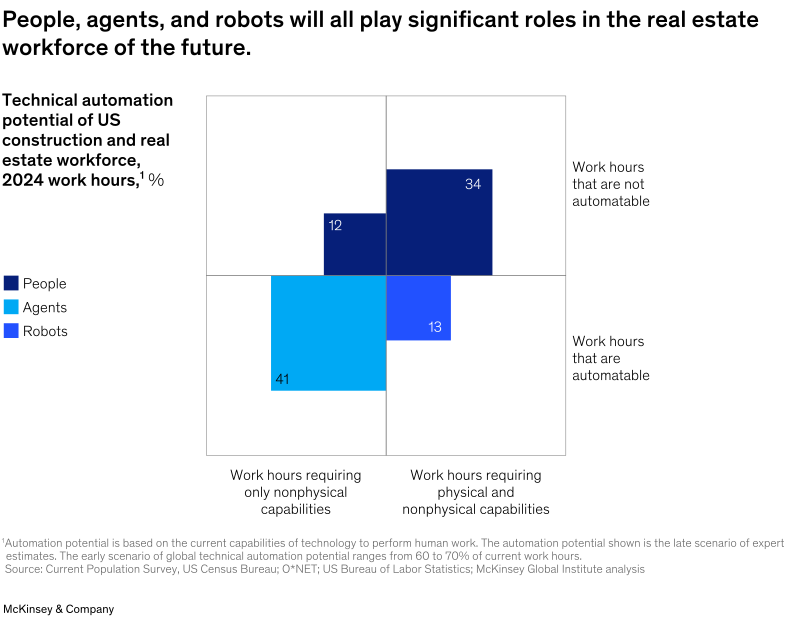
Focusing on domain-level redesign matters because it forces organizations to develop permissions, integrations, and governance that enable AI agents to execute key tasks. Teams can then review trace data generated from agents’ activities and use those insights to standardize and improve workflows. In this environment, organizations can improve week over week rather than pilot over pilot (see sidebar, “Automate steps and protect thoughts”).
Automate steps and protect thoughts
Most domains can be decomposed into two ingredients: steps and thoughts (exhibit). Steps are repeatable tasks that benefit from speed, consistency, and clean handoffs. They pull context from systems, draft a standardized message, route for approval, schedule work, update status, and log the outcome. Thoughts are judgment calls that require discretion: exceptions, trade-offs, expressions of taste or creativity, gestures that preserve trust, and decisions that carry financial, reputational, or regulatory risk.
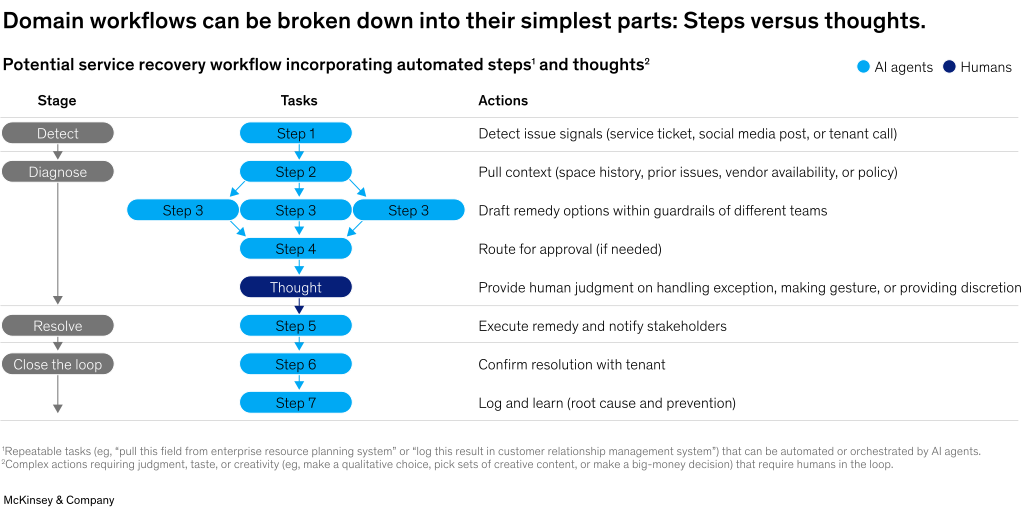
The operating model move is straightforward: automate steps aggressively and protect thoughts deliberately. You do not need to automate every decision to unlock value. In many workflows, the biggest gains come from eliminating the “chasing work” around a judgment moment: assembling context, drafting options inside policy guardrails, routing to the right human, and then executing the chosen path quickly and consistently. As organizations think about role definition and job descriptions, thoughts become the anchor, with the agentic workforce supporting the best possible outcomes for these human moments.
Over time, as governance matures and data quality improves, some thoughts can become controlled steps (converted into rules, thresholds, or supervised patterns), while the highest-stakes judgment remains human. That is how domains become learnable systems rather than one-off automations.
Taking a domain approach also forces organizations to be explicit about who captures value, which matters as much as technical feasibility in real estate. Enhancing domain-level workflows with AI can help owner-operators boost income and improve service directly. For third-party operators and service providers, AI can open the door to new commercial models with clearer alignment on how their work creates value for them and for owners. Investors can benefit differently by underwriting operating model changes that translate into more durable performance. Across the value chain, leaders should be explicit about who pays for domain transformations, who shares the upside, and who owns the trace data that allows systems to keep learning.
The five technical layers
Agentic AI succeeds or fails on a company’s technology architecture. Without the right architecture, agents can’t work together, or with humans, to meaningfully reshape workflows.
In practice, most agentic AI deployments require five technical layers, each with a clear job. When one layer is weak, organizations end up with impressive demos that cannot scale. Here are the key functions that each layer can perform:
- Factual layer. This layer makes real estate data and documents usable by collecting clean property, unit, lease, vendor, and project metadata; consistently identifying tenants, units, vendors, and projects across systems; reliably retrieving information from documents; and serving as a clear source of truth when systems disagree.
- Orchestration layer. This layer can plan and route work by identifying event triggers, workflow breakdowns, routing logic, escalation rules, and “stop points” when confidence is low or risk is high (such as approving a big-ticket vendor invoice, getting finance approval for an anchor tenant’s upcoming renewal concession, or increasing a tenant improvement allowance).
- Action layer. This layer can execute work by securely integrating AI tools into property management systems, customer relationship management systems, service platforms, procurement systems, and project controls to create tickets, schedule work, request approvals, update status, and log outcomes.
- Control layer. This layer provides governance by managing permissions, approvals for financial transactions and policy exceptions, audit trails, and monitoring (including testing and evaluation) so leaders can see what happened, why it happened, and whether performance is drifting.
- Building-block layer. This layer delivers a library of small, reusable agent blocks (often called “atomic agents”) and routines (such as “draft a stakeholder update,” “pull a clause or term from a document,” “route for approval,” “write back to a system of record,” and “close the loop”). The same block can be tuned for different parties and contexts (such as residents, vendors, owners, or property managers) without rebuilding the capability.
This last layer is what enables real scaling. The winning operating models will not be built around a single heroic agent that tries to do everything. They will be built from atomic agents that do a small thing well, with clear boundaries. These atomized pieces can then be built into tools that are deployed at the domain level and improved over time.
How to protect trust and human judgment
In real estate, agentic AI can create value by protecting trust within an organization through governance, returning time by eliminating handoffs, and giving people room to do what only people can do—in turn, improving customer satisfaction and trust.
Residents remember how you handled one bad moment, not nine routine ones. Office tenants remember whether you solved the problem fast, not how sophisticated your portal looked. Owners and lenders remember whether your reporting holds together under stress. When agents handle routine steps consistently, people can focus on the work that requires judgment, taste, creativity, and presence: negotiations, escalations, exceptions, and the moments when relationships are on the line. Successful agentic deployments in real estate will automate steps aggressively to give people the time and space they need to deliver strong, trustworthy service.
Organizations need to develop a thorough understanding of potential risks associated with agentic AI, including vulnerabilities that could disrupt operations, compromise data, or erode trust. Agentic systems must be designed with controls that match the risk: role-based permissions, human approval where required, audit trails, and clear separation between advisory outputs and actions taken. McKinsey’s work with pioneering agentic organizations reveals that the emerging operating model involves humans and agents working side by side at scale, with governance as a core design pillar, not an afterthought.
The biggest challenge to creating value from AI tools will be getting people to adopt and trust them. In high-expertise workflows, people do not outsource judgment just because software is available. They trust automation when they can understand it, supervise it, and step in without breaking the flow. That means building scaffolding into the workflow: clear review points for higher-risk actions, simple indicators of uncertainty, and concise summaries of what the system did and what it touched. When something goes wrong, teams need a clean way to intervene, recover, and learn, not a black box that forces them back to manual work. This also means early versions of AI pilots may have manual “approval” steps that teams choose to automate only once they gain confidence in what is in production (for example, automating when the approve button is clicked the vast majority of the time).
There is another, quieter risk. If every owner and operator deploys the same agent, trained on the same patterns and speaking in the same safe, generic tone, brands get diluted. Real estate is both a workflow and a feelings business. The goal is to automate the friction around the interaction so humans can focus on making sure the brand shows up with more consistency in the moments that matter, not to automate the emotion out of the interaction.
The four key domains
As real estate leaders consider how to reimagine workflows with AI, four high-value domains stand out—those that combine high volume, messy handoffs, and real performance consequences. Organizations that deploy AI in these domains should focus on creating measurable business outcomes, not on adoption metrics. It does not matter how many people use a tool if the metrics that matter—from more signed leases to faster maintenance responses—do not improve.
Maintenance and facilities: From dispatch to done automatically
Maintenance is where trust is won or lost, one tenant at a time. In most organizations, maintenance still runs on handoffs among human workers: receiving a report, opening a ticket, dispatching staff or vendors, securing approvals, updating residents, and processing invoices.
Rather than building one agent that “does maintenance,” organizations can redesign the incident workflow end to end: signal, triage, access, dispatch, updates, approvals, closeout, and learning. This is where poor coordination and preventable loss tend to hide. Organizations we have worked with to automate maintenance processes have seen time savings of more than 30 percent on many workflows.
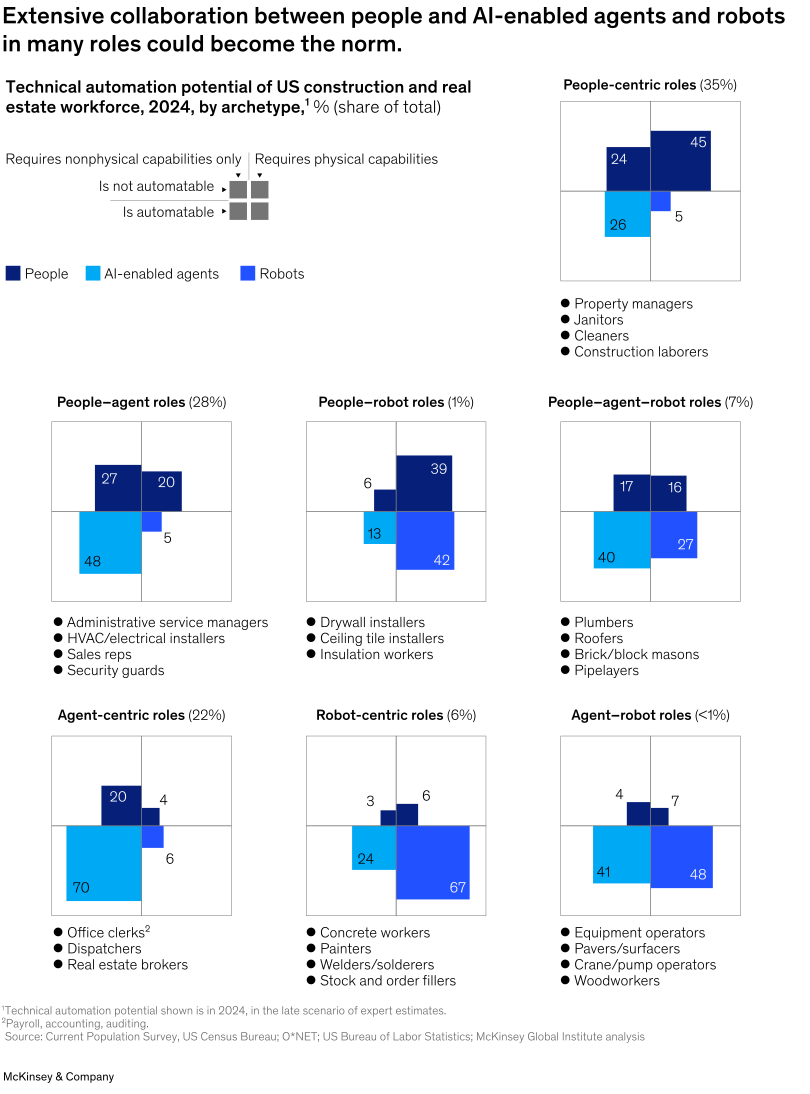
Take the example of the leaking pipe we described at the beginning of this article. From the first signal, agentic systems can ensure routine steps are handled quickly and consistently, with human managers providing review and approval where required. Maintenance staff and vendors can then focus on solving problems rather than chasing information. This is just one area where the future workforce becomes a collaboration between people, agents, and, in more physical settings, robots: for example, property and community managers partnering with agentic systems, and maintenance, repair, and skilled-trades workers supported by smarter dispatch, diagnostics, and coordination (Exhibit 2).
Leasing and renewals: Service, speed, and compliance
Leasing is often described as marketing, but for real estate operators, the process is about two things: managing logistics and building trust with tenants.
Those two forces show up in the same places every day: responsiveness, scheduling, documentation, and follow-through. When those steps break, trust breaks with them. Agentic AI can manage routine coordination work (guided by clear policies and escalation rules) so people can spend more time where they matter most: exercising judgment, showing empathy, and handling exceptions well.
A digital concierge can respond consistently across channels and languages using approved information and clear escalation rules. But in high-trust settings, how the system communicates matters as much as what it says: Tone, transparency, and escalation cues should be designed so residents understand what will happen next and when a person is involved. Done poorly, these systems converge on the same bland voice; done well, they make the brand feel more distinctive and present.
From there, the operational wins are straightforward. Tour scheduling can use real-time availability, reduce no-shows, and handle rescheduling without losing the thread. Application support can help applicants complete documentation, reduce errors, and quickly route exceptions to human reviewers. The common theme is removing friction from a high-volume workflow while making accountability and handoffs cleaner.
Renewals can benefit from the same approach. Agentic workflows can flag churn risk among tenants by noticing signals such as repeated unresolved service issues, repeated complaints about the same category, missed appointments, slower response behavior, or negative feedback trends. The system can then prompt people on the team to take action before the renewal window closes. The key is prevention: noticing a problem early enough to fix it and handle any exceptions deliberately and consistently. Embedding compliance guardrails and audit trails into the redesign from the outset is critical. Incorporating agentic workflows into the leasing process can enable timely communication, accurate information, clean documentation, and reliable follow-through. By removing friction and allowing staff members to provide more personal service, agentic workflows give on-site teams more room to deliver the human moments that tenants remember. In our work, we have seen rental organizations improve renewal rates by 3 to 7 percent after implementing AI-powered workflows. We also have worked with home builders to implement agentic workflows that have helped them improve lead response times by more than 90 percent and record incremental home sales captured by after-hours agents that engage with buyers around the clock.
Investing and asset management: Faster cycles and clearer judgment
On the investing and asset management side, most work is performed manually, such as reviewing lease clauses, analyzing performance factors, preparing investment committee materials, then updating the same story every time the numbers change.
Deploying agentic AI in this domain is not about replacing judgment. It is about removing the friction that delays judgment. In many teams, the friction is practical: Facts live in multiple systems, lease abstractions and key dates are locked in documents, performance narratives get rebuilt in slides and spreadsheets, and updates require time-consuming rework. By the time the material is ready, decisions are already late.
Organizations can create a portfolio where agents can search structured lease and operating data, draft standardized materials with clear sourcing, and detect early warning signals to prompt swifter intervention. They can handle repeatable tasks such as pulling data, drafting outreach, scheduling, summarizing information, logging outcomes, and updating systems.
Humans can then focus on issues where judgment calls are critical: exceptions, discretion, tenant relationships, brand choices, capital allocation, and investment decisions. The payoff is speed, but also consistency, defensibility, and auditability.
Construction and capital expenditures: Controlling complexity
Before a shovel hits the ground, construction is an incredibly complex endeavor. The domain is defined by documentation, sequencing, coordination, and change. An agentic redesign can support project teams with project-control capabilities that keep documentation organized and workflows moving.
Agentic systems can draft and organize requests for information, meeting minutes, submittals, and project documents. They can interpret codes and specifications to support compliance. They can automate workflows such as permitting or coordinating bid packages. They can help keep owners informed with timely updates. They can support subcontractor onboarding and mobilization by coordinating required documentation and sequencing early steps.
As capabilities mature, construction workflows can also benefit from more technical integrations, such as comparing building information modeling with site conditions, monitoring for schedule risk signals, and flagging change orders that exceed review thresholds. The goal is fewer dropped threads, faster cycle times on routine documentation, clearer visibility into risks before they become delays, and more disciplined change-order management because the paper trail is complete.
Envisioning real estate’s AI future
For real estate organizations, the choice is not whether to adopt AI. It is whether AI sits on the side of core systems as a set of helpful tools, or whether it becomes an operating advantage by being integrated into redesigned domains.
For organizations that take a domain-focused approach to AI adoption, three futures can unfold at the same time. They are not mutually exclusive. In practice, most organizations will experience elements of all three, depending on the asset class, market, and starting point.
New operating systems emerge
In five years, the most distinctive real estate owners and managers may look less like collections of properties and more like operating systems. Not in the branding sense, but in the practical sense that their portfolios run on a common layer of workflows, data, and controls.
In that world, a building is not “smart” because it has sensors. It is smart because the organization can turn signals into action. Service requests trigger predictable chains of work. Exceptions are routed, approved, and documented in the same way every time. Reporting becomes a by-product of execution rather than a monthly scramble.
The compounding effect is what separates the leaders from the laggards. Every work order leaves behind information that improves routing. Every service resolution teaches the organization how to prevent the next issue. Every capital project sharpens sequencing and vendor performance. Over time, the portfolio becomes a teacher.
The concept is simple, but it requires discipline. Start with one domain where outcomes matter and activity is high. Wire it into systems of record, put approvals and audit pathways in place, measure a real outcome—then repeat.
Coordination layers quietly disappear
A meaningful share of real estate work today exists to manage handoffs: chasing documents, confirming status, following up on approvals, reconciling expectations and results. Coordinating all that requires countless meetings, full inboxes, and often heroic effort.
As workflows become more automated, the middle layer of chasing begins to thin out. The work changes, and by extension, the jobs hired for also change. The organization spends less time pushing paper and more time managing outcomes. Teams that once coordinated activities by memory and relationships will depend on systems to carry the thread.
The winners will be the organizations that reinvest the time freed up into areas of true differentiation: resident and tenant experience, negotiation, crisis leadership, and continuous improvement. Roles will be redesigned alongside workflows. Managers will learn to supervise systems, not just people. Humans will stay in control of the moments that matter.
Value creation gets harder
In the third future, execution improves across the industry, and quick wins diminish. Reporting gets cleaner. Work orders become more predictable. Service becomes more consistent. As a result, organizations will need to focus on how they differentiate themselves.
In this future, competitive advantage migrates twice. First, it shifts to firms that can build compounding learning loops in core domains to boost efficiency and performance. Then, as those capabilities spread, it shifts again to what cannot be commoditized: trust, brand, relationships, and investment conviction. AI can sharpen each of those, but it cannot substitute for them.
True strategic advantage will come from executing AI tools at scale and learning from this process. When workflows run through an agentic layer, every ticket, approval, exception, and resolution leaves a trace of what happened, what was decided, and what worked. Over time, those traces become proprietary operational know-how that improves the next decision. That creates a strategic question leaders should ask early: Who owns the learning loop—the owner, the property manager, the software vendor, or the services provider?
This is also why AI vendor partner choices matter. Many platforms converge on a lowest-common-denominator experience because that is what scales across clients. The risk is subtle. Tenant-facing automation gets smoother while the brand gets flatter, and service becomes easier to standardize and compete on price. Differentiation comes from what you control: proprietary workflow design; the trace data that make your system learn; and a deliberately designed voice, tone, transparency, and escalation behavior that preserve trust and reinforce the brand’s distinctiveness rather than muting it.
Over time, some players will try to bundle software and service delivery into a single operating system offer. The organizations best positioned for success will be those that own the workflows, own the learning loop, and keep the customer experience unmistakably theirs.
What separates leaders is discipline, not ambition. They decide which domains they intend to own. They ensure they control the data traces created by executed work so the organization keeps learning. They design governance that allows systems to act safely. And they treat adoption as a business responsibility, not an IT project.
The winners will not be the firms with the flashiest demos. They will be the ones whose systems quietly get the work moving before the day begins, so people can focus on judgment, relationships, and the moments that matter in the built environment.
In real estate, as in other industries, measurable benefits from AI adoption have been slow to materialize. But the rapid development of agentic technology represents an opportunity for real estate leaders to rethink how they generate value from AI.
The next phase is unlikely to be won by a series of disconnected pilots. It will be won by a small number of domain transformations designed for execution and trust. Organizations that move early can use agents to reduce handoffs, improve service, and accelerate decision cycles while building the governance and operating model that makes those gains durable. Done with discipline and risk controls, agentic AI can unlock new levels of efficiency, enhance customer service and experience, and fuel continuous improvement, delivering a true competitive advantage.