The skies are clearing in the aerospace and defense (A&D) industry. After a pandemic-era lull, commercial aviation companies are posting consistently wider margins amid expectations that production rates could double over the next decade on the back of fleet modernization and rising demand for air travel. Meanwhile, the defense sector is generating impressive shareholder returns amid expanding profit pools and rising global spending.
Positive market dynamics in A&D is good news for the industry as a whole, but not all companies are making the most of the opportunity. Many face challenges that extend deep into their operations, capabilities, and ability to plan for—and invest in—growth. These weaknesses often manifest in poor inventory control, and they can be exacerbated by supply chain uncertainty and weak operational planning. McKinsey research shows that since 2016, inventory turns have fallen by more than 35 percent and inventories have ballooned by more than $70 billion, even as commercial aircraft deliveries have declined to 1,300 from 1,700 (Exhibit 1).
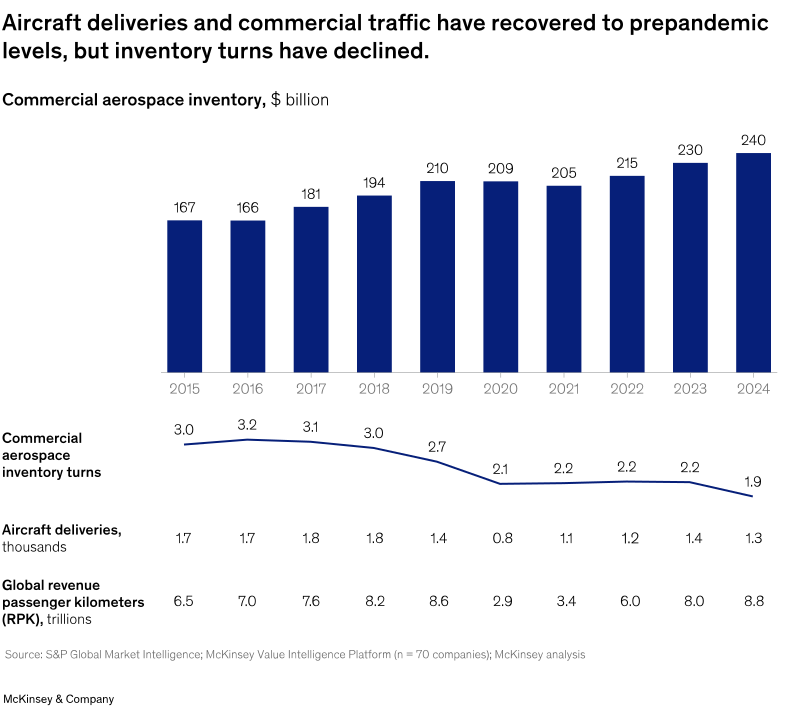
As they plan for the decade ahead, some A&D decision-makers have put inventory management at the top of their agendas. With the help of AI, they have started to forensically monitor the dynamics shaping supply and demand, sharpen their forecasting, and plan more effectively for supply chain uncertainty. With these benefits in hand, they have improved their management of both operations and cash flows, ensuring their inventories are optimized to support their ambitions for growth.
Improved performance but an inventory drag
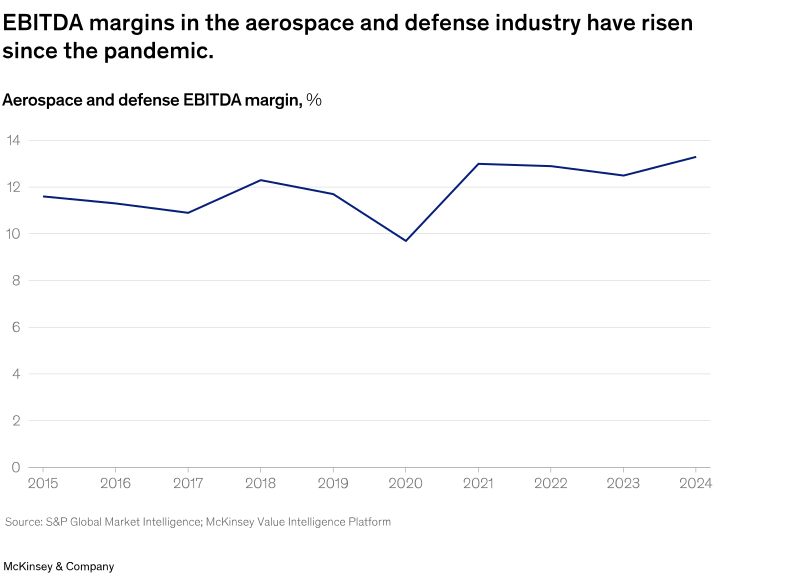
After experiencing a dip in activity during the pandemic, A&D profitability has improved, with the industry’s average EBITDA margin rising to 13.3 percent in 2024 from 12.2 percent in 2015–19 (Exhibit 2).1 Better profitability has been driven by factors including extended aircraft and platform lifespans (which have fueled aftermarket sales), rising defense budgets, and inflation-busting spares pricing (which has been supported by escalation formulas tied to labor and material costs).
Supply chain challenges, while still an issue, no longer stand out as the single most important item on C-suite agendas. Indeed, according to McKinsey analysis of earnings transcripts, commentaries on shortages in executive earnings calls peaked in early 2022 and have declined steadily ever since (Exhibit 3). That said, the shift in focus may also reflect the emergence of geopolitical trade tensions and tariffs, which could have overshadowed supply chain concerns.
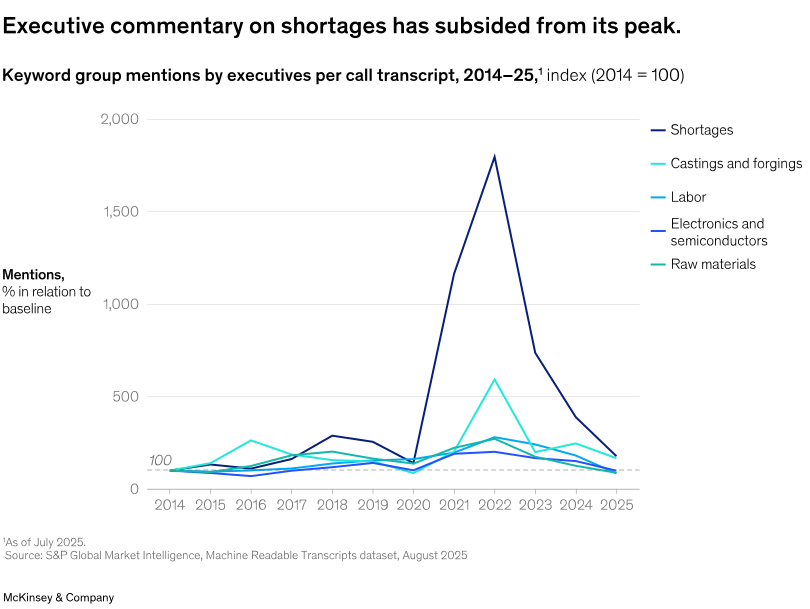
Earnings calls notwithstanding, our pulse on industry sentiment, coupled with the persistent glut of unused inventory on shelves and shop floors, suggests that the supply chain issue has not completely abated. Indeed, it may be too complex to resolve by simply waiting for bottlenecks to subside. And deeper, more systemic issues require strategic, long-term solutions rather than short-term fixes.
One deeply embedded challenge involves trust in the value chain. OEMs often doubt their suppliers’ ability to meet delivery expectations and, as a result, set production targets they know are unrealistic. Decision-makers often worry that taking their foot off the pedal will lead to even lower output. Suppliers, in turn, often view OEM forecasts as unreliable and are reluctant to invest in materials and capacity for what they see as unattainable goals. A compounding factor is the widespread use of long-term agreements containing flexible commitments, which create a ripple effect of volatility through the supply chain. The result is that one party’s inefficiencies become shared inefficiencies, and these further erode trust and undermine collaborative planning.
The stakes are high because supply chain instability has a direct impact on working-capital resources. And without reliable capital flows, the commercial industry will be unable to ramp up to the predicted production rates of 2,500 aircraft annually by 2034.2 Similarly, working-capital challenges will constrain defense companies’ ability to meet rising demand.
The drag of slow-moving inventory
To break free from inventory gridlock, A&D decision-makers must first focus on what they can control. But in doing so, they need to move beyond the “what” of inventory management—categorizing materials as raw goods, works in progress, or finished goods—to develop a deep understanding of the “why” behind inventory buildup. In practice, this requires decision-makers to align on a realistic production plan grounded in triangulated demand signals and a clear-eyed assessment of industrial capacity. From there, they can determine their company’s “inventory entitlement,” which is the optimal level of inventory required to support healthy operations. In our experience, the analytical exercise often reveals startling levels of excess inventory. For example, some aerospace manufacturers have found that as much as 60 to 80 percent of the value of parts on hand is not needed to support the next 12 months of production.
How should decision-makers tackle this excess? We believe much progress can be made by using a data-driven approach to predict demand signals and constrain inflows of unnecessary materials. Similar analysis can free up cash for operations and investment while reducing holding costs and mitigating the risk of obsolescence. Beyond financial benefits, better use of data can help companies stabilize production schedules, improve workforce planning, and rebuild trust with suppliers. Thus, addressing inventory inefficiencies becomes not just a tactical fix but a strategic lever to restore vitality to the supply chain, strengthen supplier relationships, and position the organization for sustainable growth.
Improving inventory performance
For A&D leaders, shifts in production dynamics, defense budgets, and trade conditions present an opportunity to reassess the key drivers of performance and create a step change in inventory management. Best practices include the following:
1. Build an independent, fact-based view of demand
Leading aerospace companies go beyond simply taking orders to develop independent perspectives on demand. This requires rigorous analysis of customer performance and market signals, which in turn enables accurate triangulation of demand signals. With advanced planning tools and AI and machine learning (ML) models, companies can streamline their analyses, leading to more accurate forecasting and more proactive decision-making. In parallel, it makes sense to revisit commercial and contractual relationships with the aim of forging trusted partnerships that can help translate insights into actionable commitments across the supply chain.
2. Understand and anticipate supply constraints
Effective cash and inventory management is predicated on a clear view of both internal and external constraints. Companies need to account for contingencies such as raw-material shortages, labor availability, capacity bottlenecks, and systemwide dependencies. Anticipating where these bottlenecks may arise, such as in critical parts or specialized processes, enables better decision-making on matters such as safety stock, investment, and alternative sourcing. Early indications often exist, even if they are not directly visible, and AI can help managers identify them. Without this visibility, even the best demand forecasts can fall apart.
3. Manage for volatility with flexibility and adaptability
Volatility is a constant in the aerospace industry—whether from demand fluctuations, production challenges, or macroeconomic shocks. Rather than passively monitoring change, companies need to actively plan for it. This means building flexible operations, maintaining buffers where necessary, and embedding agility into planning cycles. Tools such as time-phased “burn down” plans, inventory control towers, and cross-functional scenario planning can help companies adapt quickly while protecting cash and delivery performance. The goal should be resilience in the face of inevitable disruption—not perfect stability.
The time to act is now
The A&D industry stands at a critical juncture, with rising profitability and expanding demand masking deeper operational and supply chain inefficiencies. Addressing inventory challenges is therefore not just a tactical necessity but also a strategic imperative to support sustainable growth. And time is of the essence. We estimate that if the industry does not act urgently, it risks burning through an additional $60 billion in cash to support ramp-up plans. On the other hand, if companies adopt data-driven approaches to streamline operations, optimize working capital, and foster trust in the value chain, they can break free from inventory gridlock and capitalize on the sector’s potential in the decade ahead.