Success in B2B sales has long depended on a few enduring capabilities: understanding customers’ needs, building trusted relationships, and delivering solutions that create real value. Those capabilities still matter. But our latest research shows that the standard sales playbook is no longer enough to achieve breakout growth.
Based on our 2026 B2B Pulse Survey of nearly 4,000 buyers and sellers across 13 countries, together with in-depth interviews with revenue leaders at global companies, we see a widening gap between B2B growth champions and laggards. Increasingly, AI is becoming the key differentiator, but not for companies that are simply adopting tools.
In fact, most B2B companies are already doing something with AI. The problem is that few are capturing material value from it. Fragmented data, weak insights, manual processes, disconnected teams, and limited change management continue to restrict impact. Adding AI on top of these constraints rarely changes performance. It often just automates complexity.
What sets growth champions—those growing faster than their peers—apart is their ambition to rewire key workflows end to end. High-growth companies are three times more likely to have increased AI investment by double digits in 2026 year over year—71 percent versus 25 percent.1 Those getting value from those investments aren’t just rolling out enterprise-wide tools, but redesigning core workflows around agentic AI.
Commercial workflows—what we call “impact journeys”—are some of the most impactful to rewire and deliver the outcomes that matter most: faster growth, sharper pricing, shorter sales cycles, better customer engagement, and lower cost-to-serve ratios. These impact journeys bring together data, decision logic, human judgment, and AI agents across the full arc of commercial activity, from opportunity identification and account planning to pricing, proposals, execution, and post-sale growth.
In 2025, we identified gen AI use cases that were already delivering measurable results across the B2B deal cycle. The five impact journeys in this report represent the next evolution. When connected with agentic AI, these five journeys fuse individual capabilities into continuous workflows that span the full arc of commercial activity—from opportunity identification and account planning to pricing execution and post-sale growth. They bring together data, decision logic, human judgment, and AI agents so that the gains from each AI use case compound rather than remain isolated.
This shift does not make the human side of B2B sales less important. It makes it even more valuable. AI agents can take on more of the searching, synthesizing, drafting, and administrative work, while sellers focus on relationship building, problem solving, and judgment-rich customer conversations. But that only works when companies completely rewire the commercial operating model. This looks like maintaining the data that feeds agents, keeping humans in the loop, redesigning roles, and embedding new ways of working across commercial teams. It goes without saying that every rewiring must be built upon the omnichannel foundations that are now the minimum requirements to compete.
This report deciphers how B2B companies can move from AI experimentation to agentic-fueled growth at scale. It provides a practical guide, informed by interviews with top commercial executives and case examples from companies that have achieved early success. Chapter 1 lays out five priority impact journeys that can be rewired with agentic AI at the center. Chapter 2 describes the operating model shifts needed to make the change stick, scale adoption, and turn productivity gains into durable margin improvement.
Chapter 1: Rewiring commercial impact journeys with agentic AI
Over the years, AI has advanced from rules-based tools to predictive models, which now underpin agentic systems capable of orchestrating end-to-end workflows. Sales and marketing have been at the center of this wave. Companies are experimenting with tactics such as hyper-personalization, next best opportunity identification, account intelligence, AI-enabled pricing, and automated requests for proposal (RFPs).
Some have seen promising early results. In our 2026 B2B Pulse Survey, growth leaders that have embedded AI directly into core workflows identify the primary benefits as seller efficiency (59 percent of respondents) and better customer experiences (53 percent of respondents)—two factors that often lead to higher sales growth. In our experience, financial services companies, for example, that rewired prospecting and relationship-management workflows with agentic AI achieved 3 to 15 percent higher revenues per relationship manager and 20 to 40 percent lower cost-to-serve ratios.2
Despite the promise of scaling agentic AI across end-to-end workflows, the practice remains rare, with fewer than 10 percent of organizations having scaled AI in any given function.
This is the current AI paradox in B2B sales. Adoption is increasingly widespread, but value capture is limited. Most companies have focused on rolling out enterprise-wide gen AI tools. These tools can improve employee productivity, but their economic impact is often diffuse. The bigger prize comes from applying agentic AI to specific workflows—in this case, the end-to-end sales process—to create measurable value.
Growth leaders are redesigning workflows around the most important personas in the commercial impact journey: the seller and the customer. They focus on giving commercial teams new superpowers to replicate what the best sellers do intuitively: Synthesize signals, prioritize opportunities, tailor solutions, and center every interaction on customer value (exhibit).
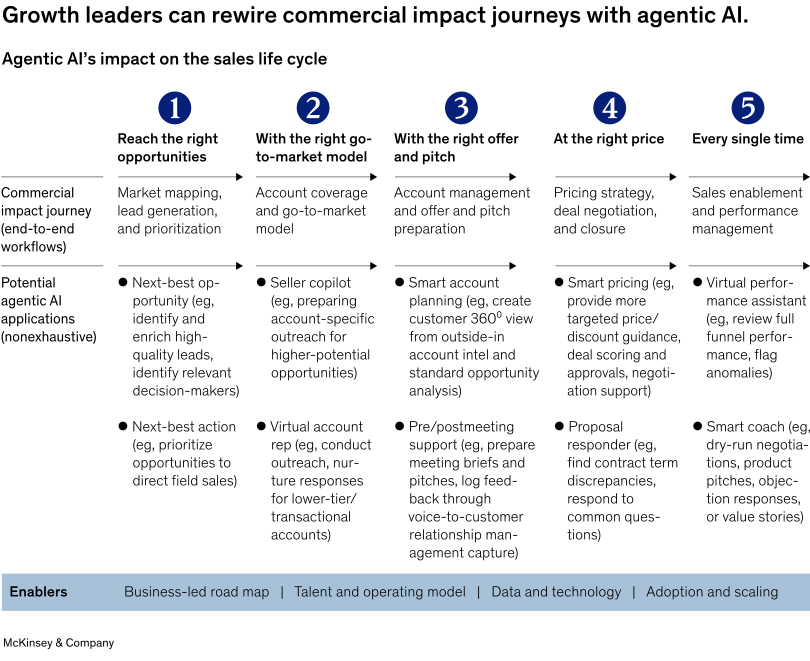
The result is not a more automated version of transactional selling. It’s an insight-led model of solution selling—one that allows humans to spend more time deepening relationships and shaping better outcomes for customers. At the heart of this shift is a move from fragmented use cases to end-to-end impact journeys. Below we outline the five priority impact journeys that can be rewired with agentic AI to create a new commercial operating system.
Reach the right opportunities
For many B2B companies, market opportunity mapping has historically been a manual, sporadic, and often fragmented exercise, too disconnected from frontline action. Strategy may identify attractive segments, marketing may generate leads, and sellers may surface opportunities through customer conversations at trade fairs. But these efforts often run in parallel. As a result, companies may sense where demand is emerging, yet struggle to pinpoint the right accounts, prioritize leads, and move fast enough to capture them.
With agentic AI, growth champions can reimagine this workflow as an end-to-end impact journey: converting external and proprietary data into high-quality warm leads and routing them to the right sellers. AI agents scan sources such as directories, news, filings, hiring trends, procurement activity, product launches, and regulatory signals to identify leads and buying triggers. They enrich account profiles with firmographics, strategic priorities, likely customer needs, and decision-makers. And they score opportunities by value potential, fit, timing, and likelihood to convert before dispatching warm leads to sales teams with a recommended play, outreach angle, and next best action. Importantly, that does not stop with a company’s application playground as it exists today. It can also point to whitespace opportunities that could be served in adjacent applications, through product enhancements, or even future innovations.
Using agentic AI for precision market mapping
“Customers are making different decisions than they’ve ever made, and they’re putting capital to work in different places than they’ve ever been. What used to change on a yearly planning cycle now changes continuously. The challenge is getting the right message in front of the right buyer, solving the right problem at the right moment.
That’s why we’re investing so heavily in leveraging AI to understand customer signals and where customers are in their journey. You need to understand total addressable market (TAM), the serviceable addressable market (SAM), and the serviceable obtainable market (SOM). Some people get the SAM, but they don’t go to SOM. AI is helping us understand what our sales-obtainable market is and how to go after it. We can have agents working 24 hours a day monitoring customer and market signals, helping us understand who is ready to engage and how we move more customers into that SOM faster.”
– Shane Paladin, chief customer and revenue officer at Equinix
With agentic market opportunity mapping, growth champions can turn their growth priorities into specific commercial choices. The result is a fine-tuned growth engine: one that helps commercial teams focus on the right applications and customers.
Companies can act on market signals faster than competitors, build a clearer view of emerging customer needs, and surface new opportunities. For sellers, this makes the job easier: They receive not just a lead, but a clear view of why the account matters, what needs are emerging, and how to engage.
Get the go-to-market and people model right
Go-to-market (GTM) models often have not kept pace with the economics of customer coverage. High- and low-value opportunities can receive too-similar treatment, even though their margin potential, likelihood to convert, and cost to serve differ sharply. Sellers may spend too much time on accounts with limited upside, while higher-potential opportunities do not always get the coverage, cadence, or channel mix they deserve. The result is a sales model that leaves ROI on the table: Resources are not consistently directed to where value sits.
With agentic AI, growth champions can reimagine GTM as an end-to-end impact journey. AI makes it possible to tailor coverage more dynamically based on customer value, margin opportunity, and cost to serve. For high-value accounts, agents act as copilots—validating opportunities, generating account-specific messages and value propositions, preparing outreach, and recommending next best actions. For lower-tier opportunities, agents can take on more of the motion directly: conducting outreach, nurturing responses, interpreting intent, capturing needs, scheduling meetings, and handing off once a lead is warm and sales ready.
Agents and account executives working together
“For salespeople to be effective in their roles, they’re going to have to manage agents. The role of the account executive is still building relationships, driving timelines, and getting deals across the line, but increasingly it’s going to be a person working with an agent at every step.
What we’re doing is using more agents and AI in the sales motion and focusing human expertise on helping customers build a better mousetrap. Where I think we’re going to continue to need humans is to really sell people on reference architectures and the technical reasons behind these decisions. You’re going to see hyper-generalists supported by technical specialists, and the companies that get through that transition quickest are going to have a real advantage.”
– Shane Paladin, chief customer and revenue officer at Equinix
This type of human-agent coordination can improve sales ROI. Sellers spend more time where judgment, relationships, and solution shaping matter most, while agent-led motions cover lower-value opportunities. Agents preserve context across touchpoints, personalize messages at scale, coordinate follow-ups, and route opportunities to the right seller or channel. The result is a GTM playbook that is both more targeted and more scalable.
Done well, agentic GTM orchestration helps companies move faster, improve conversion, and reduce cost-to-serve ratios. Companies implementing AI-powered next-best-experience programs to identify the most impactful sales motions have reported 5 to 8 percent revenue uplift and 20 to 30 percent lower cost-to-serve ratios.3
Grow accounts with the right offers and perfect pitches
For many B2B companies, account management remains episodic and seller dependent. Strategic account plans are built periodically, meeting preparation is often manual, and post-meeting notes frequently disappear into CRM fields without shaping the next commercial move. As a result, companies miss opportunities to grow existing accounts through cross-sell, targeted pricing actions, better offer tailoring, and win-back.
With agentic AI, growth champions can reimagine account management as an end-to-end impact journey: from strategic account planning over tactical meeting preparation to post-meeting action generation. AI agents first build a live “customer 360” view by combining outside-in account intelligence—such as company news, leadership changes, investment plans, major events, and industry trends—with a standard set of internal opportunity analysis tools. These could include solutions such as a cross-sell identifier that directs sales reps toward the highest-value product opportunities or a churn detector that flags lost volumes with potential to win back.
Individually, these analyses have been possible for years. But agentic AI can bring them together with richer account context, continuously refreshing insights to prioritize the few actions that matter most. Instead of asking sellers to interpret separate reports on volume, price, or churn, agents can synthesize the full picture into a targeted set of opportunities to improve absolute customer value.
Personalizing pitches with AI
“AI reduces administrative tasks for territory managers so they can instead focus on learning what their customers really need. Having this understanding makes a territory manager much more valuable than just a person who walks in the door of a clinic with a canned sales pitch. Every customer wants a salesperson to understand their business—someone who can help them make the right decisions to grow their practices—and AI is enabling that.
AI is also helping us understand which products are responsive to sales rep promotion versus those that would do just as well via marketing campaigns. That means our reps are becoming knowledgeable about eight to ten key products versus having limited knowledge of 65 different ones. They can really talk about the impact of those products in ways that excite customers. Change management helps reps feel confident with AI. But it’s important to remind them that tech could never replace what they know firsthand about their customers and their local geographies.”
– Jason McKinney, senior vice president of commercial sales at Dechra
The workflow then moves from planning to execution. As sellers plan their week and prepare for customer meetings, AI agents generate concise premeeting notes, tailored outreach, and pitch materials based on the latest account intelligence and prioritized commercial actions. After the meeting, voice-to-CRM tools capture the discussion and translate notes into structured data points—such as competitor references, product needs, objections, and follow-up commitments. This process turns visit reports from a graveyard of unstructured data into sources of actionable insight that feed the next account plan, meeting, or opportunity.
For sellers, this makes account management easier and more effective. They spend less time assembling information and more time deepening relationships, shaping better solutions, and acting on the highest-value growth opportunities in each account.
Ensure the right price
For many B2B companies, resetting pricing remains one of the most impactful ways to accelerate the commercial engine, yet change is still often episodic instead of systematic. Decisions are still anchored in static price lists, internal transaction history, and the individual judgment of sales reps who are disconnected from real-time signals further up the value chain. Reactive discounting fills the gap, and hundreds of full-time employees each touch a slice of the pricing workflow without ever seeing the whole picture. The result is wide, unexplained variance in realized prices, slow approval cycles, and value leakage in contracts that no one spots until well after the deal is closed.
How agents can deliver precision pricing
“We're using agents for pricing recommendations. They function as deal calculators, combining historical performance, customer-specific context, and predicted future needs to make recommendations. Rather than manually assembling quotes, reps are presented with data-driven recommendations optimized for the customer's situation. This allows sellers to spend less time developing pricing options and more time uncovering and validating the client's real business problems—while agents help translate those needs into the right commercial solutions.”
– Vice president of revenue operations at a global B2B technology company
With agentic AI, growth champions can reimagine pricing as an end-to-end impact journey, from seeing the right price through setting it to getting it. To see the price, agents pull external signals from raw materials, supplier moves, regulatory shifts, and competitor scrapes—translating them into structured, dynamic guidance rather than static lists. To set the price, dynamic deal scoring engines compare each opportunity against like-for-like won deals and micro-segment peers, so the system can recommend the right combination of list price, bundle, service terms, and service-level agreements (SLAs) at the moment of quote. To get the price, autonomous pricing agents adapt the quotation to lift deal score, trigger the right approvals, draft the customer email, and send the final quote—while agents continuously scan for value leakage, off-policy discounts, and contract terms worth reopening at renewal.
For sellers, this type of automation makes pricing easier and more defensible: They walk into negotiations with a transparent view of what a fair price looks like for this customer, this product, and this competitive context. The shift is already underway. In a recent McKinsey survey of more than 400 B2B pricing executives and decision-makers, 65 to 85 percent expect to adopt gen AI or agentic AI in pricing over the next one to three years, up from just 10 to 30 percent today.4
Enable sellers to deliver every single time
In B2B sales, inconsistent information across teams is now the number one reason buyers switch suppliers—ahead of inability to access knowledgeable representatives and inability to track orders across channels. That finding, from our 2026 B2B Pulse Survey, underscores why point solutions are not enough: When sellers receive fragmented or conflicting signals, the inconsistency flows directly to the customer and erodes trust. Advantage increasingly comes from helping more sellers perform like the best ones, consistently across every interaction.
Yet commercial performance management often remains too broad and inconsistent. Reviews focus on lagging indicators or high-level pipeline movements, while concrete execution issues—missed follow-ups, stalled deals, pricing leakage, or weak conversion moments—receive too little attention. Coaching varies widely by manager, making improvement episodic rather than systematic.
With agentic AI, growth champions can reimagine sales enablement as a continuous performance improvement journey. At the center is a performance enablement cockpit that scans performance and opportunity data to identify anomalies, execution leaks, and improvement ideas. Agents analyze CRM data, pipeline movement, conversion outcomes, and activity patterns to surface where performance can improve—by customer, product, deal stage, or seller.
AI for coaching sales reps
“We’re reimagining the role of the sales manager from performance inspector to sales coach. Historically, managers spent much of their time reviewing pipeline reports, analyzing performance metrics, and manually scoring a small sample of sales calls. Today, AI can listen to every customer interaction, evaluate it against both sales skill and product knowledge models, and automatically surface coaching opportunities at both the individual and organizational level. That allows managers to spend less time diagnosing performance and more time driving the highest-impact coaching interventions.”
– Vice president of revenue operations at a global B2B technology company
The workflow then connects insight to action across the full performance enablement journey. Before critical moments, sellers can rehearse with voice- or scenario-based agents to dry-run negotiations, product pitches, objection responses, or value stories. During and after customer interactions, agents can provide coaching prompts, targeted learning journeys, or support embedded in live selling. Teams can see which behaviors distinguish top performers, where capability gaps hurt conversion or price realization, and which interventions are most likely to improve outcomes. Coaching shifts from periodic training to daily support in the seller’s flow of work.
The impact journey works only when paired with strong manager-led coaching. Win rooms and one-on-ones should be anchored in the cockpit and focus primarily on what to do next, not just what happened. Done well, agentic AI moves sales organizations from inconsistent, manager-dependent coaching to a systematic model of continuous improvement—building capability, raising productivity, and helping more sellers perform at their best.
Chapter 2: Organizational shifts to rewire the commercial organization
Agent-enabling core commercial workflows can unlock profitable growth. But value does not come from inserting AI agents into today’s sales model. It comes from redesigning the commercial organization around end-to-end impact journeys—changing how decisions are made, how teams collaborate, and how sellers create value with customers. High-performing companies are nearly three times more likely to have fundamentally redesigned individual workflows around AI than their peers. This reinforces the case that the organizational shifts below are not optional enhancements but structural requirements to create value.5
Building end-to-end agentic workflows requires profound organizational change. Companies need to move beyond isolated use cases and one-off deployments and build the capabilities to rewire their commercial organization. This is the essence of our Rewired approach: combining a value-backed road map with the talent, operating model, data, technology, and adoption capabilities that allow them to continuously improve customer experience, seller productivity, and unit economics. Getting there requires a tight handshake between business and technology leaders: Commercial leaders can best define the value, priority impact journeys, adoption model, and performance outcomes, while technology leaders help translate those priorities into scalable data products, modular architecture, secure agent design, and reliable operations.
And it requires commercial organizations to make four fundamental shifts: Build a business-led roadmap around the highest-value impact journeys; redesign the talent and operating model for human–AI teams; create the data and technology spine that enables trusted recommendations; and treat adoption and scaling as the core of transformation.
Business-led road map
The first shift on the path to agentic-AI sales transformation is to establish a commercial roadmap that moves the organization from isolated use cases and tech-forward pilots to a business-backed workflow transformation. Point solutions such as voice-based meeting summaries, email drafting, or proposal generation can improve individual tasks, but they rarely change commercial performance on their own.
Rather than layering AI onto scattered sales tasks, leaders should identify which workflows matter most and where agentic AI can unlock the greatest value. These workflows span the entire customer life cycle, including opportunity mapping, account planning, lead and pipeline management, offer preparation, pricing, and negotiation—all the way through to retention. Each workflow should be assessed for how agentic AI could unlock growth and productivity and positively affect seller and customer experiences.
Rewiring sales with AI
“AI is a business transformation topic, not a technical initiative. AI is about bringing people along and fostering a culture of experimentation. Otherwise, you still conduct business the old ways with just a new gadget. Adopting AI in the commercial organization is especially tricky as sales is a people business. To get this right, leaders must first identify which real challenges their sales teams face and then create AI initiatives that deliver on commercial objectives. They must make the life of sales easier and put the right incentives in place to support adoption.
Ultimately, AI will elevate the commercial team rather than replace it. The real competitive advantage will come from combining it with uniquely human skills: the ability to build trust-based relations, to strategically contextualize, and to co-create with AI-powered insights and decision-making. And that only happens when you treat data as a technical asset and strategic capability. A strong data foundation makes the AI-driven transformation possible.”
– Monique Buch, chief commercial officer at Covestro
This type of change requires senior sponsorship. Rewiring workflows cuts across structures, incentives, governance, and data ownership. Leaders need to define the vision, quantify value, prioritize the road map, and move fast enough to learn and compound value. Done well, the roadmap becomes a transformation agenda that redesigns work around the seller and customer, improves experience, expands seller capacity, and widens competitive distance.
Talent and operating model
The second shift is to redesign talent and the operating model. Companies need to move from the siloed commercial functions of sales, marketing, pricing, and customer service to a connected, AI-native model built around human–AI teams and impact journeys.
The design principle is straightforward: AI augments the seller’s capacity while preserving the human relationships, contextual judgment, and co-creation that define complex B2B selling. Automating routine tasks can lead to substantial value creation. Our experience shows that implementing agentic AI in even one of the five impact journeys can free up an additional 10 percent of seller time.6
AI-native talent and operating models will reshape roles and structures. Existing GTM roles—account owners, business development, customer service, pricing, and enablement—will be augmented by AI as agents take on more work across the sales journey. New roles will emerge, such as AI workflow designers and agent managers. The organization may become flatter, with fewer handoffs, stronger orchestration across commercial functions, and a different concentration of frontline sellers as inside sales, self-serve, lower-cost channels, and agentic models cover more of the market.
Account executives illustrate the shift. As agents support prospecting, account intelligence, proposal preparation, follow-up, and CRM capture, account executives can move from administrative coordination to strategic account ownership, executive engagement, complex deal shaping, and relationship-building. Sales teams will need support, upskilling, and clear communication about evolving roles, especially for experienced leaders who may be more apprehensive about working alongside agents.
Fostering AI-and-human teams requires a culture of continuous learning: always-on performance tracking, personalized coaching, revised incentives, and regular role reinvention will be required as humans and agents learn to work together. Done well, the result is broader coverage, lower cost to sell, more consistent execution, and more seller time spent where value is won.
Change management will be essential. For many salespeople, the simpler tasks that filled their days will largely disappear, replaced by supervising agentic workflows. All that will be left is the more difficult work of building relationships with buyers. Thus, leaders will need to guide their teams on how to move from a mindset of “meeting targets” to “creating new opportunities.” With this type of work commanding a higher cognitive load, commercial teams may need more breaks or collaborative team-building activities to reach maximum productivity.
Data and technology
The third shift is to build the data and technology spine that allows agentic AI to scale—moving from ad hoc datasets and disconnected systems to reusable data products and a modular revenue tech stack that support priority impact journeys. This spine cannot be built by IT alone. It requires a tight handshake with the business: Commercial leaders own the value, data domains, and workflow requirements, while technology leaders ensure the architecture, tools, security, and operations can scale.
For most established companies, data is the harder problem: Agents cannot create trusted recommendations if customer, product, pricing, transaction, or interaction data remain fragmented or poorly governed. Growth champions treat data as a business capability. A common learning is to place data ownership in the business, with one team accountable for each critical domain, such as customer, product, pricing, or interaction data. Each domain needs a data owner and stewards responsible for priorities, critical data elements, quality standards, and issue resolution. This creates reusable data products that serve multiple impact journeys: Market opportunity mapping, customer 360 intelligence, pricing actions, and performance coaching all rely on many of the same underlying data products.
Then, an agentic layer accesses legacy automation and AI tools to generate the insights, recommendations, and actions each journey requires. These outputs flow into the GTM applications and interaction layers used by sellers, managers, marketers, pricing teams, and customer success teams.
Adoption and scaling
The fourth shift is to design for adoption and scaling from day one—rather than building agentic AI and then pushing adoption as an afterthought.
Our research suggests that for every $1 spent deploying AI, companies may need to spend $3 on change management.7 Yet most organizations invert this ratio.8 For commercial organizations, value accrues when AI changes daily behavior across impact journeys: how commercial teams find opportunities, prepare, price, follow up, and manage performance.
Growth champions treat change management as equal to technology deployment. To get this right, leaders need to make life easier for sellers and create the right incentives to bring people along. That means building aspiration through role modeling, super users, and networks of multipliers; building AI fluency through prompt support and embedded coaching; and strengthening the commercial skills—prospecting, value selling, negotiation—that AI amplifies rather than replaces.
Commercial organizations also need to anchor each impact journey in clear P&L levers and redesign the performance cockpit. That means linking behavior metrics, such as tool usage and acceptance of AI pointers, to leading indicators, such as pipeline velocity and conversion speed of AI-touched warm opportunities, and then to lagging outcomes, such as margin growth and closed-won pipeline. Incentives should reflect the realities of human–AI teams, while AI-enabled win rooms and one-on-ones help managers turn insights into action.
Scaling requires early choices on where to start and how to expand. Leaders should sequence by impact journey, cohort, and product maturity; prioritize use cases with broad relevance; use feedback loops to improve each release; and allow targeted tailoring for specific segments or go-to-market models. Done well, adoption becomes how the commercial organization runs: Agents improve the work, sellers trust the outputs, managers coach from the same facts, and impact journeys compound value over time.
Agentic AI has moved firmly inside the growth engine. But the future of B2B sales will not be defined by which company deploys the most tools. It will be defined by those companies that rewire the commercial playbook around end-to-end impact journeys. Companies able to capture the most value from agentic AI will focus on the outcomes that matter: growth, margin, productivity, and customer experience. And they will redesign their operating models to bring agents and humans together to deliver on these goals.
The five impact journeys in this report are not a menu of use cases. They are the building blocks of a new operating model: identifying the right opportunities, growing accounts with better offers, improving go-to-market execution, pricing more effectively, and helping more sellers perform like the best. Used in isolation, agentic AI may create incremental gains. Embedded into these journeys, it can fundamentally change how the revenue engine creates and captures value.
This report can serve as a guide for sales leaders to initiate or accelerate their own transformation. Their goal is to align on the highest-value journeys, redesign workflows around sellers and customers, and build the data spine, governance mechanisms, and adoption playbook required to rewire the commercial organization—not just complete a technology rollout. Done well, a transformation of this caliber can make B2B sales both more digital and more human. Agents do more of the heavy lifting, while sellers spend more time building trust, shaping solutions, and helping customers create value. The leaders willing to rewire the commercial playbook now will define the next era of B2B sales performance.