Do you think of Walmart as a media or technology company? If not, maybe you should. More than half of Walmart’s operating-income growth now comes from its newer growth platforms: online retail media, membership services, and marketplace operations.1 For a business founded on everyday low prices and physical stores, this development reflects something bigger: Walmart has been on a more than decade-long journey to deliberately build new engines of growth on top of its core, and those engines are now materially reshaping performance.
Walmart’s performance may not seem out of place at a time when the S&P 500 has enjoyed an exceptional run, with a 15 percent CAGR over the past five years.2 But more than half of the index’s gains in 2024 were concentrated in the so-called Magnificent Seven.3 Six in seven companies have actually failed to achieve double-digit revenue growth over that time.4
In that context, Walmart’s profitable business growth stands out, but it is not alone. Our analysis in the latest installment of our research series on growth whittled down the performance of a broad range of companies to 61 businesses that outperformed their peers in profitable revenue growth over the past five years (see sidebar, “About the research”). These top 15 percent of companies outstripped their peers by an average of five percentage points in revenue growth and seven percentage points in profitability annually, translating into a five-point edge in total shareholder returns.
What sets them apart is not luck or timing. It is how they commit to growth, how they develop growth engines, and how they accelerate with technology.
How leaders get ahead and stay ahead
We identified three common characteristics that leaders embody to drive sustained, profitable business growth and outperform the competition.



Consistent commitment to funding business growth
To fund growth, you have to fuel it. While every CEO says growth matters, outperformers translate growth ambitions into concrete, sustained commitments. They articulate a clear growth strategy, commit resources to it, and move decisively.
This level of commitment is evident in how growth outperformers invested through downturns. They continued to fund R&D, launch products, and build capabilities while peers slowed spending—typically investing multiples more than competitors. Leaders do not treat growth as a one-time plan but as an ongoing process, regularly refreshing portfolios and entering new categories.
A diversified portfolio of business growth engines
Outperformers build a portfolio of growth engines over time rather than relying on one or two bets. They strengthen the core business, expand into close adjacencies, and test new sources of growth, allocating talent and capital to each with clear accountability.
Crucially, this portfolio is actively managed and well executed. Leaders track performance closely, double down on growth engines that are working, and stop or pivot initiatives that are not delivering. Many turn to adjacencies that build on existing assets, such as omnichannel models or platform-based businesses.
Technology as an accelerator to value
Business growth leaders know how to harness technology not just to drive growth but to accelerate it. They are successful because they don’t simply develop use cases but systematically integrate data, digital tools, and AI into strategy, operations, and decision-making.
That focus is evident today, with many top growers investing in AI to redesign end-to-end workflows, improve speed and precision, and unlock new business opportunities. A deliberate mix of organic investment and targeted M&A helps build capabilities to accelerate pace.
By the numbers: The data behind business growth leaders
The 61 outperformers we identified (Exhibit 1) share two key business growth identifiers: above-median revenue CAGR and above-median profitability. Many peers grow revenue but dilute their margins while doing so; outperformers engineer growth engines that scale margins.
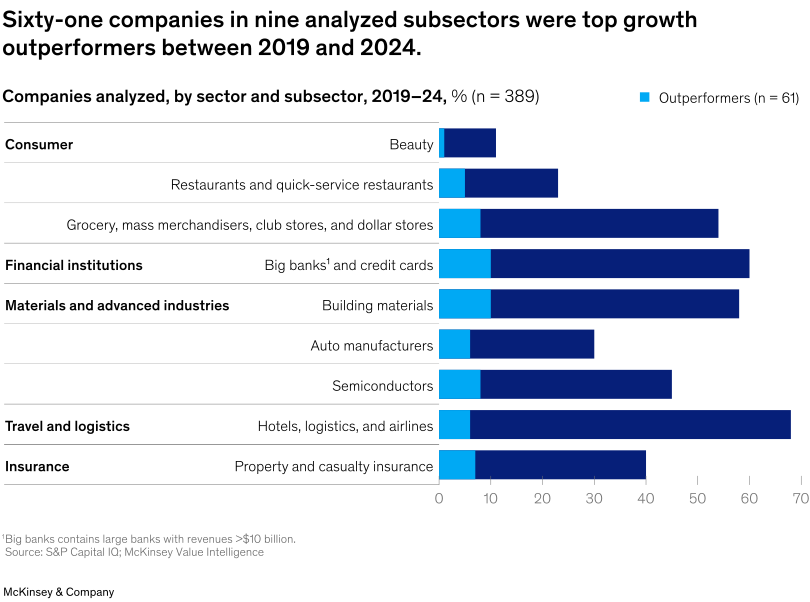
From 2014 to 2019 and 2019 to 2024, 34 percent of the companies we analyzed moved up to a higher quartile in their sector in revenue CAGR, while about the same number (35 percent) moved down. Notably, 16 percent of companies in the lowest quartile moved to the top quartile outperformer set in revenue CAGR.5 These are sizable shifts, underscoring the ability of companies to improve. Every sector has multiple outperforming companies, except beauty, where only a single company counted as an outperformer.
McKinsey’s projections estimate that 18 future business arenas could generate $29 trillion to $48 trillion in revenue by 2040. While competing in these arenas increases a company’s chances of growing, doing so doesn’t guarantee that it can outperform the market. To beat the market, companies have to develop better strategies and build stronger capabilities.
Beating the market: Leaders’ stories
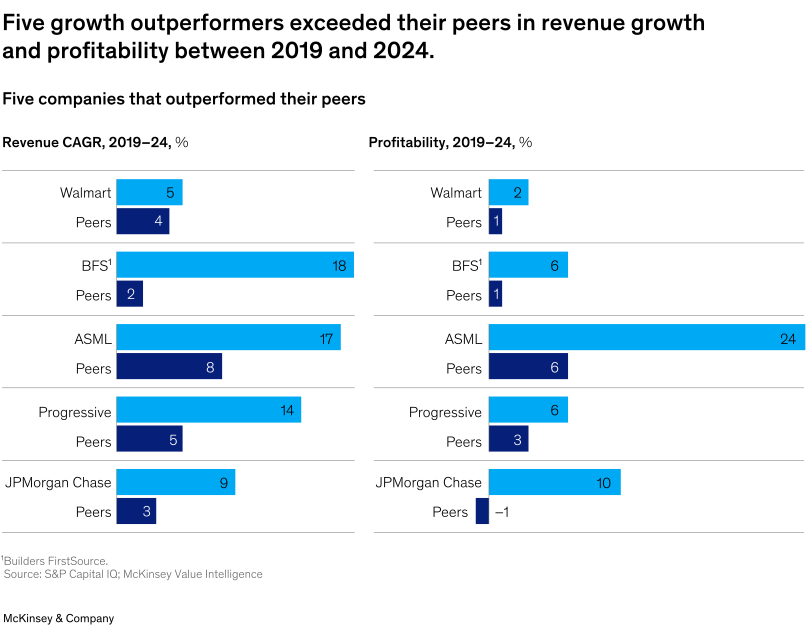
We analyzed the practices of five companies to better understand how they continually outperformed over the five-year period of our analysis (Exhibit 2). Each of these companies operates in an industry where the majority of peers failed to achieve profitable growth over the same period. Their stories illustrate how different choices, aligned with the three business growth themes, helped them beat the odds.
Retail: Walmart’s business growth mindset
The pandemic accelerated the shift to e-commerce, while inflation later squeezed consumer spending, particularly among lower- and middle-income households. Through this volatility, Walmart’s leadership stayed committed to growth. Instead of slowing investment, the company continued to fund growth by building new capabilities, growth engines, and technology—both organically and inorganically—even when near-term returns were uncertain and the market was skeptical.
That commitment showed up in Walmart’s deliberate effort to build a diversified portfolio of growth engines alongside its core stores. Over time, Walmart transformed from a predominantly offline retailer into the largest omnichannel and second-largest e-commerce player in the United States. It did so by acquiring more than 20 digital-native and tech companies, scaling a third-party marketplace, and launching Walmart+, a membership program whose members now spend roughly twice as much as nonmembers.6
Walmart also pushed into adjacencies, such as retail media. Built on Walmart’s customer reach and transaction data, its advertising business has grown rapidly and accounted for roughly 30 percent of operating profit in 2024—a powerful driver of margins and valuation.7
Underlying these growth engines is an operating model with technology at the core. Walmart has invested heavily in data, automation, and AI to rewire how the business operates, from predictive maintenance in stores and distribution centers to AI-enabled customer service across digital and physical channels8 to drone delivery.9 These capabilities not only improve efficiency but also accelerate the scaling of Walmart’s growth platforms.
The takeaway
Walmart’s results are anchored in its ability to invest through uncertainty and deliberately create a broad portfolio of breakout growth engines on top of its core. By building a portfolio of platform businesses and using technology to scale them across its massive footprint, Walmart turned disruption in retail into a source of durable, profitable growth.
Building materials: Builders FirstSource’s diversity and scale
The building materials industry has experienced sharp swings, with a COVID-19-era boom in new construction and renovation followed by supply chain disruptions, labor shortages, and rising interest rates. Input costs have risen by roughly 40 percent since 2020, while higher borrowing costs slowed housing transactions and depressed demand for both new construction and remodeling.
While many companies struggled to adapt, Builders FirstSource (BFS) maintained a consistent commitment to fuel its growth, both organically and inorganically. To build a diversified portfolio of growth engines, BFS made a series of acquisitions, which helped make it the largest building materials supplier in the United States. But scale was not the end goal. BFS used M&A to move beyond commodity distribution and expand into higher-margin manufactured components, installed services, and value-added solutions. These adjacencies reduced exposure to pure volume swings and strengthened relationships across professional builders, contractors, and developers so BFS could grow even as end-market demand softened.
To accelerate its growth, BFS invested heavily in digital platforms and automation to modernize the builder journey. Examples include its “myBLDR” digital ordering and design tools, factory automations, and logistics optimization. These capabilities improved speed and accuracy while enabling sales reps to cross-sell higher-margin products and services.
The takeaway
BFS’s path to outperforming was defined by funding growth during a volatile cycle and using M&A to assemble a diversified portfolio of higher-margin adjacencies. By pairing that scale with digital platforms and automation, BFS reduced its exposure to commodity swings and built a more resilient, technology-enabled business growth model.
Semiconductors: ASML’s chip shot
AI has fueled huge economic profit growth in the semiconductor industry across equipment players, fabless players (which design, develop, and market their own chips), and foundries (which manufacture the chips).
In this field, ASML (an equipment player) has emerged as a business growth leader. The company recorded a revenue CAGR around ten percentage points higher than that of its median peers from 2019 to 2024.10 Long before AI became a dominant force, the company committed capital to advanced lithography and expanded capacity while maintaining a high rate of innovation execution.
This foundation provided ASML with the ability to strengthen and expand its growth engines. While its core remains lithography systems, ASML expanded into software, metrology, and a growing services business in line with its commitment to developing products and services tied to its customers’ technology road maps. Partnerships with, or acquisitions of, companies (for example, Brion Technologies, HMI, Cymer, and Berliner Glas Group) have provided ASML with capabilities that deepened customer relationships, reduced supply chain risks, and enabled high-margin, recurring revenue from upgrades and maintenance. These moves made lithography systems more valuable for customers and tightened integration across design, exposure, and inspection.
To power this growth, ASML has integrated technology into its operating model. Its customer coinvestment program secured long-term demand, reduced investment risk, and strengthened its leadership in extreme ultraviolet (EUV) lithography. At the same time, ASML invested heavily in supply chains and manufacturing resilience to support scale and reliability. More recently, partnerships such as a minority stake in Mistral AI reflect a commitment to staying at the fore of technological innovation.11
The takeaway
ASML stands out for committing capital years before demand was certain and deepening its core technology beyond what peers could match. That long-term investment, supplemented by thoughtful acquisitions, unlocked high growth in its core and in adjacencies such as software and services, allowing ASML’s advantage to compound.
P&C insurance: Progressive’s technology bet
From 2019 to 2024, growth in the property and casualty insurance sector was driven largely by price increases rather than policy expansion, while rising claims costs compressed profitability.12 Progressive, however, delivered revenue growth of roughly 14 percent annually—nearly three times the growth rate of its peers—while maintaining strong profitability.13
Rather than relying on price alone, Progressive’s strong results reflected its continued investment in tech-intensive capabilities such as Snapshot (for individual auto) and Smart Haul (for commercial trucks). These moves have helped Progressive price more accurately and attract safer drivers.
That focus on technology is further reflected in Progressive’s efforts over decades, integrating data, analytics, and AI into pricing, underwriting, claims, and marketing. Machine learning models (via H2O.ai, Snowflake) enable faster fraud detection, billing optimization, and granular pricing. Telematics, along with sustained product innovation, have helped Progressive deliver superior segmentation, detect cost changes earlier, and deploy rate adjustments faster than the rest of the industry, supporting both growth and profitability. 14
The takeaway
Progressive’s success reflects how deeply embedded data and technology can improve and accelerate business growth. By investing consistently and using analytics and AI to power pricing, underwriting, and new growth engines beyond premiums, Progressive grew faster and more profitably than peers in an otherwise constrained industry.
Banking: JPMorgan Chase’s bold discipline
Rate volatility, regulatory swings,15 and rising customer expectations for seamless digital experiences have put pressure on traditional models, made planning difficult, and created more opportunities for fintech disruption.16 Despite these challenges, JPMorgan Chase has distinguished itself by committing to growth—expanding into adjacencies to reduce reliance on any single growth driver, rewiring operations with technology, and remaining willing to change course when conditions shifted.
That commitment showed up in a series of bold but disciplined decisions. During the COVID-19 pandemic, when many banks were shrinking their physical footprints, JPMorgan Chase built roughly 900 branches to deepen customer relationships. As digital adoption accelerated, however, the company quickly adjusted, consolidating locations rather than clinging to past choices. This ability to invest early, learn quickly, and pivot has become a defining advantage.
JPMorgan Chase also built a diversified portfolio of growth engines across consumer, corporate, and wealth businesses. It acquired First Republic Bank in 2023 to add about $92 billion in deposits and secure a high-net-worth client base.17 At the same time, JPMorgan Chase funded new offerings such as buy now, pay later, consumer lending products, and digital treasury and payments solutions.18 These moves were designed to broaden revenue streams and reinforce the core, not simply “buy” scale.
At the center of this strategy is a tech-enabled “acceleration engine,” investing $18 billion annually in technology—more than its peers.19 Those investments enabled faster product launches, improved risk management, and enterprise-wide use of generative AI to streamline workflows and support decision-making. These investments also helped the firm stay ahead of regulatory change while improving efficiency. Investors have noticed: JPMorgan Chase’s price-to-book ratio ranged from 1.5 to 2.0 from 2019 to 2024, surpassing its peers’ equivalent ratio of 0.9 to 1.2.20
The takeaway
JPMorgan Chase’s advantage came from committing to growth while deliberately diversifying its growth engines to future-proof the core. By combining adjacencies in payments and lending with sustained, large-scale technology investment, the firm expanded relevance and resilience as banking economics and customer expectations shifted.
Leading tomorrow: Questions for leaders
Building a company that grows consistently ahead of its peers takes effort, resources, and commitment. But, as our stories show, even large, well-established companies can compete and win—growth is not just the arena of start-ups.
Leaders at companies with aspirations to outperform should consider these questions:
- Consistent commitment to business growth.
- Are our growth aspirations and commitments bold enough to allow us to grow faster and more profitably than the market?
- Do our resource allocations match our growth priorities?
- Development of a diversified portfolio of business growth engines.
- How many independent growth engines do we actually have today—and how many rely entirely on the core?
- Which adjacencies genuinely build on our strengths, and which are distractions dressed up as growth?
- Innovation engine with technology at the core.
- Where can AI and agentic AI help us build up our competitive advantages?
- Which strategically critical capabilities should we build organically, and which would benefit from being developed through thoughtful partnerships or acquisitions?
What distinguishes business growth leaders is not better foresight but greater conviction. They invest when uncertainty is highest, build capabilities rather than chase headlines, and treat growth as something to be engineered rather than hoped for. In a world where only a small minority truly outperforms, those choices increasingly determine who pulls ahead and who falls behind.