De minimis exemptions, which waive duties, taxes, and extensive customs procedures on low-value goods, have fueled the rapid expansion of international e-commerce in recent decades. Over the past year, however, several governments have lowered de minimis thresholds or eliminated the exemptions altogether in response to fiscal pressures, enforcement priorities, or geopolitical dynamics. The changes affect billions of parcel shipments, with considerable cost and supply chain implications for exporters (particularly retailers of low-priced items) and logistics companies. For government agencies, meanwhile, the new rules create an opportunity to modernize data collection and deepen cross-agency collaboration.
Governments adjust de minimis thresholds for a variety of reasons. They may increase the thresholds to promote cross-border commerce, even if this decreases customs revenue and potentially heightens competition for domestic firms. Conversely, they may lower the thresholds to lend a boost to domestic companies and increase customs revenue. Since cross-border e-commerce—worth $500 billion globally in 2024 and estimated to exceed $1.3 trillion by 20301—has largely entailed parcels covered by de minimis exemptions, numerous organizations are affected by the recent changes. Beyond the operational and strategic impact on individual retailers and logistics companies, the new de minimis rules may contribute to broader rearrangements in trade as exporters seek trading partners with import-friendly policies.
Changes in de minimis exemptions have spanned the globe:
- The United States eliminated its $800 de minimis threshold for all consignments.2
- The European Union has announced the removal of the duty exemption on imports valued below €150.3
- The United Kingdom is reassessing its current £135 threshold for low-value imports.4
- Türkiye reduced its de minimis exemption from €150 to €30 in 2024 and increased import duties by 10 to 30 percent.5
- Brazil has made several changes since 2023, most recently proposing to replace its threshold for per shipment de minimis exemption with an annual exemption of up to $600 per taxpayer.6
- Japan is considering abolishing its ¥10,000 (approximately $65) de minimis threshold or making it apply solely to sellers registered for the Japanese value-added tax (VAT).7
- Vietnam removed its de minimis exemption on imports below 1 million Vietnamese dong (approximately $40).8
The impact on trade flow has been substantial. In 2024, 1.36 billion de-minimis-exempt parcels worth $64 billion entered the United States; all these parcels would now be subject to duties.9 When the US government eliminated the exemption for goods from mainland China and Hong Kong in May, the daily volume of imports exempt from de minimis dropped by more than 85 percent.10 Following the subsequent removal of de minimis exemptions for all exporters in August, total postal shipments to the United States declined by 80 percent as postal services in several European countries temporarily suspended shipments due to confusion about the changes.11
Despite these disruptions, trade volumes are already recovering as exporters adapt. Some companies are redirecting flows to alternate channels: UK parcel delivery company Evri, for example, reported a 30 percent surge in US-bound deliveries following the UK postal suspension.12 Large Chinese e-commerce platforms, such as Temu and SHEIN—which have been disproportionately affected by the exemption changes—are quickly adjusting their logistics strategies. Temu, for example, has been moving inventory to warehouses closer to end customers and building regional networks for order fulfillment.13 Meanwhile, Amazon Haul, the retailer’s low-cost marketplace that offers many products originating in China, has expanded to the United Kingdom, Germany, Mexico, and the United Arab Emirates, among others, as a way to diversify from the US market and address both the elimination of de minimis exemptions and higher tariffs on Chinese imports.14 These moves mirror a larger trend of export-driven companies in Europe and the United States nearshoring production in response to trade disruptions.15
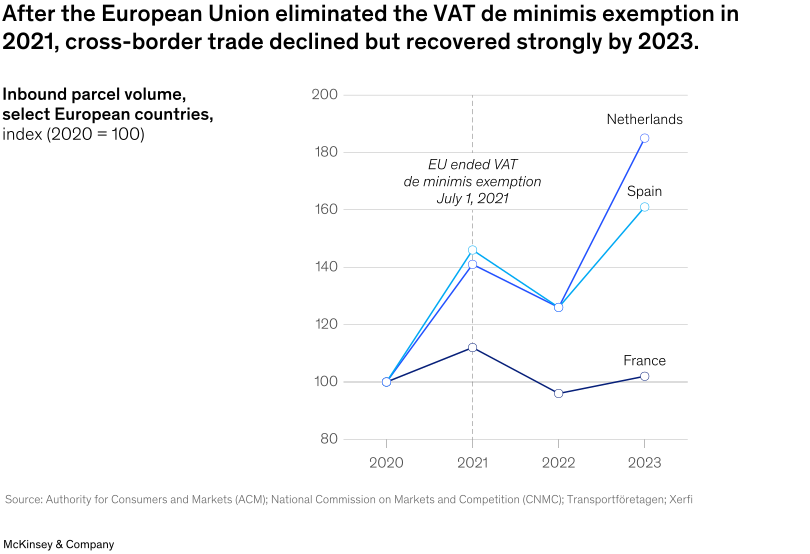
Large exporters may be able to absorb the additional costs that the elimination of de minimis exemptions entails. When the United States abolished de minimis on Chinese imports in May, Temu’s US gross merchandise value (GMV) fell to less than 30 percent of the figure at the start of 2025. By July, however, the company’s GMV recovered to more than 60 percent of past levels.16 This pattern of a sharp drop followed by a quick recovery is in line with earlier trade disruptions. For example, when the European Union removed de minimis exemptions on the VAT in 2021, the change increased the cost of Chinese imports by roughly 20 percent.17 While these imports experienced a steep decline in 2022, that was followed by an even steeper surge the following year, propelled by the country’s leading e-commerce marketplaces (exhibit).
Implications for players across the export value chain
Changes to de minimis exemptions affect the entire export ecosystem, from customs agencies and governments to exporters and logistics providers. However, each category of organizations faces different challenges—and potential opportunities. While all participants in cross-border trade have had to quickly adapt to the evolving landscape, those short-term moves could be augmented by actions that help make organizations resilient over the long term.
Exporters
While de minimis changes apply to all exporters, retail businesses are the most exposed to the rules’ impact. Leaders should review their supply chain strategies and may need to strengthen their compliance capabilities. The following steps can help exporters prepare for and respond to new de minimis policies:
- Boost compliance capabilities. Customs formalities, such as declarations and supporting documentation, may attract greater scrutiny to ensure compliance with new policies, making their accuracy more critical than ever. Aggressive interpretation of the rules could lead to financial penalties and reputational harm. Businesses may need to build out their compliance infrastructure—for example, by deploying trade management software that automates classification, valuation, and documentation of goods. Exporters could also develop or purchase tools to calculate landed costs and compliance risk before shipping. Training employees on the latest regulations and hiring local compliance teams are other steps to consider.
- Increase flexibility in supply chain and logistics strategies. Exporters can strengthen the resilience of their supply chains by diversifying fulfillment operations. This could include placing warehouses or microfulfillment centers in key markets, shifting from direct cross-border shipping to localized inventories, and developing distinct bulk- and parcel-level strategies. Some companies are nearshoring manufacturing or assembly operations to shorten lead times and reduce reliance on long-haul shipping. Chinese online marketplaces, for example, are expanding their fulfillment networks in multiple regions, such as SHEIN investing $150 million to turn Brazil into a regional export hub.18
- Review commercial, pricing, and product strategies. As trade costs and the number of compliance requirements increase, exporters should reassess not only their supply chains but also what goods they sell and where, reevaluating target markets and sales channels. Pricing and product strategies may also need to be adjusted to reflect new duties or other customs costs.
Logistics organizations
The elimination of de minimis largely affects postal and parcel delivery operators (many of which are government agencies), as they are the primary shippers of low-value goods. However, other logistics companies, such as small-freight forwarders, may also be affected. Some of these organizations rely on low-value consignments, often consolidating parcels into bulk shipments that were previously exempt from duties. With every shipment now subject to full customs declarations in the United States (and potentially elsewhere in the future), smaller logistics services could lose their cost advantage over larger competitors. Several actions can help these companies adapt:
- Review the operating model and strategy. Leaders can explore ways to differentiate their companies from larger competitors—for example, by adjusting their offerings around specific trade lanes (such as China–United States) or customer segments. Some companies may find value in diversifying services to include warehousing, regional fulfillment services, or last-mile coordination in their home markets, thus reducing reliance on the cross-border parcel flows that are most likely to be disrupted by de minimis changes.
- Strengthen compliance capabilities. Businesses that currently lack the sophisticated customs capabilities to handle new filing requirements may need to develop them, either in-house or through partnerships, to avoid bottlenecks.
- Explore adjacent opportunities. Small logistics companies could partner with integrated logistics providers to leverage those larger firms’ robust customs clearance processes while retaining existing customer relationships.
Larger logistics providers are less affected by de minimis changes, as those policies focus on low-value consignments rather than containerized freight. Additionally, their higher levels of data and tech sophistication may help them adapt their business models relatively quickly. However, potential shifts in retail supply chains toward more localized warehousing and consolidated regional fulfillment could increase demand for integrated logistics services and create opportunities over the medium to long term.
Since postal organizations have been the most commonly used channel for shipping low-cost goods, additional duties affect them disproportionately. Higher total landed costs for postal shipments may reduce the already small price difference between postal and commercial parcel delivery organizations, contributing to a shift away from the postal channel. To navigate these shifts, postal and parcel players could consider the following steps:
- Protect margins and operational resilience. The elimination of de minimis will increase the number of customs handling, data, and compliance requirements, adding cost and complexity to cross-border operations. Parcel delivery organizations may need to adapt quickly to preserve service quality while maintaining margins. Automating a higher share of customs and data processes can boost efficiency. Anticipating congestion at customs and designing contingency capacity for clearance bottlenecks, meanwhile, will help safeguard service quality. Organizations could further reduce costs by adjusting trade lane capacity (the amount of cargo shipped through a trade lane) and origin deliveries (where goods are picked up or consolidated for export), adding temporary staff to help mitigate potential disruptions, and optimizing cross-border procurement, such as by consolidating shipments with fewer airlines.
- Consider strategic repositioning. Beyond immediate cost management, postal and parcel delivery companies should reassess their strategic positioning. In the short term, this could entail focusing on new pricing strategies and offerings, such as duty-paid or bundled customs clearance services and bulk-clearance options for e-commerce clients. Organizations may also need to review their longer-term cross-border strategies, including reassessing their trade lane focus and rebalancing postal and commercial contracts. Parcel delivery operating models may also require adaptation. For example, business leaders could reduce the volume of inbound single-item shipments and redesign their supply chains for greater flexibility. Additionally, they could explore adjacent growth opportunities: Digital customs brokerage services, regional fulfillment solutions, and compliance-as-a-service offerings could become new growth engines for organizations that act quickly to secure a first-mover advantage.
Government agencies
The lowering or elimination of de minimis thresholds has several implications for governments beyond their postal organization, and three stand out. First, these moves generate an unprecedented flow of customs data, as either all or more low-value goods are subject to full customs declaration processes. This creates opportunities for higher revenue collection, better trade facilitation, and stronger inspection systems. Second, the new rules raise expectations of strong enforcement, with close scrutiny of practices such as transshipment, undervaluation, and misclassification. Third, de minimis shifts increase pressure on authorities to provide tools, guidance, and clear processes to minimize friction for businesses. Customs agencies could take several actions to modernize their capabilities:
- Invest in data tools and digital platforms. Such investment could enable government agencies to use data for faster customs clearance and zero in on high-risk shipments. They could deploy analytics and AI solutions to flag anomalies, invest in interoperable data systems to build risk profiles more effectively, and share real-time data with other agencies to detect patterns early.
- Boost workforce capabilities. Agencies can invest in their people by providing training on new processes and technologies. An increased volume of shipments subject to customs clearance could also lead to the need for additional employees.
- Deepen cross-agency cooperation. By increasing collaboration with other domestic agencies (such as border security and market surveillance authorities) and foreign governments (through data-sharing agreements, for example), customs agencies could strengthen enforcement and expand their inspection and auditing capacities. The European Union has already tightened coordination between customs and market surveillance authorities, with joint inspections, shared risk frameworks, and harmonized data exchange to close compliance gaps.19
- Provide compliance tools and guidance to businesses. By creating user-friendly digital filing systems or trade platforms and providing clear guidance, government agencies can help businesses meet their obligations while maintaining efficient trade flows.
Governments are increasingly adjusting de minimis exemptions to address new fiscal pressures, security concerns, and other strategic objectives. Over the past year, the United States abolished de minimis altogether, and other countries have signaled eliminations or reductions in existing thresholds. For exporters and logistics players, the changes have implications for their supply chains, compliance practices, and service models. For governments, these shifts could create an opportunity to leverage new data flows to enhance both enforcement and facilitation.